 |
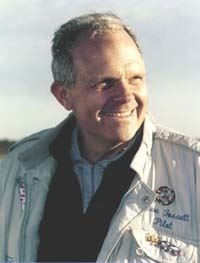
On August 17, 2001, Steve Fossett's fifth attempt at solo circumnavigation of the world ended when he faced a "minefield" of thunderstorms and was forced to land in Brazil, 20-25 miles south of Bage, near the border of Uruguay. After facing weather challenges, lack of oxygen, and slow traveling speeds, Fossett and his control team decided to abandon the attempt.
In May, 2002, according to Reuters, Fossett announced he would make his sixth attempt to circumnavigate the globe solo in a hot air balloon, one of aviation's last unaccomplished feats. Depending on the weather, Fossett would launch in mid- to late-June from Northam, Western Australia. He aimed to fly 17,000 to 18,000 miles, mostly over the world's oceans in the Southern Hemisphere as he did in a 2001 attempt.
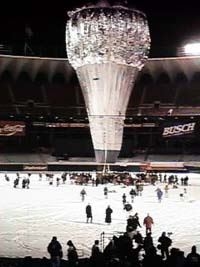 |
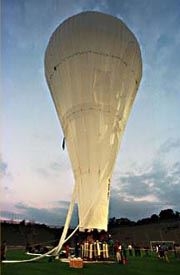
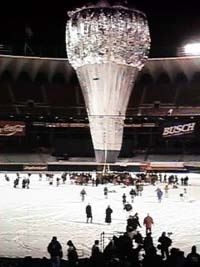
Steve Fossett is one of America's greatest living adventurers. In early 1997, he attempted to be the first person to go around the world nonstop in a balloon. Fossett used a Roziere-style mylar balloon, which operates on helium and hydrogen. This particular design helps to regulate the temperature of the balloon, which in turn conserves fuel. The balloon, the Solo Spirit, launched from Busch Stadium in St. Louis, Missouri, on January 13, 1997.
That journey lasted six days, two hours and forty-four minutes. This was the world distance record, as well as the absolute world duration record. Although he did not achieve his goal, Fossett broke two records in the attempt.
He tried again on December 31, 1997, but a faulty heater ended his journey in Novokiporovskaya, Russia, where he safely landed his balloon Solo Spirit. He had traveled approximately 7,300 miles in four days, eleven hours.
Steve Fossett has set many records. On August 7, 1998, with a full moon as his backdrop, he lifted off from Mendoza, Argentina, hoping once again to be the first person to circumnavigate the earth nonstop in a balloon.
The Solo Spirit was larger and carried more fuel than previous missions and all involved hoped that would make the difference in this first attempt in the Southern Hemisphere.
Unfortunately, on August 16th, soon after the halfway point, bad thunderstorms and hail over Australia ruptured the balloon, forcing an emergency rescue mission. Steve himself was uninjured and in good spirits. Although he was unable to meet his goal, several records were set, including the longest manned balloon flight continuously over water.
 |
Fossett, quiet and modest in person, also races cars, climbs mountains, and sails catamarans. His passion for adventure has taken him all over the world. He has not always won, but testing his own strength and endurance is a way of life for this exceptional explorer.
In 1992 he traveled 1165 miles across Alaska in the Iditarod Dogsled Race where he placed 47th. In 1985, he swam the English Channel from France to England. He has set eight official world records for sailing. He set the Pacific Ocean record from Yokohama, Japan, to San Fransisco, California, in 16 days, 17 hours and 21 minutes.
On September 7, 2007, Steve Fosset disappeared on a routine flight between Nevada and the California coast. An extensive search was conducted which lasted over a year. Fossett's friends, including Richard Branson and Peter Cohen of Amazon, engaged the assistance of Google Inc to use high resolution satellite imagery and coordinate it with a beta website using "crowdsourcing" - hoping that this might turn up some clues. After a long and frustrating search, they finally gave up. On September 29, 2008, a year and a month after Steve Fossett's disappearance, a hiker near a remote area of Mammoth Lakes came across some weathered items belonging to Steve. DNA tests conducted on some nearby bone fragments proved conclusively that Steve Fossett had indeed perished.
 |
Steve Fossett was a man full of determination and goals. His vision inspires and excites the imagination of those of us who dream, but dare not go on such fantastic journeys.
 |
Page created on 3/29/2013 6:45:48 PM
Last edited 3/29/2013 6:45:48 PM
He serves on the Board of Trustees of Washington University and is committed to making his voyages an educational experience for children around the world.
In 2003, The Circumnavigators Club honored Steve Fossett with the very prestigious Magellan Award.
Fossett has been honored around the world for his determination. In July of 2002, after completing the first solo balloon flight around the world, actor Cliff Robertson wrote:
"Just about the time the entire world has had enough - of terrorism - murders - kidnapping - corporate corruption and 'creative bookkeeping' - out of the blue sailed the 'Spirit of Freedom' and Steve Fossett. He has reminded this troubled world that dreams are real - can be realized, if the holder is willing to hold tight with the grip of belief. Thank you, Steve Fossett, for helping this weakened world to hang in there - to tighten its grip of hope - and to never give up."

In June, 2002, Steve Fossett began his sixth attempt to circumnavigate the globe in a balloon called the Solo Spirit. He launched the Solo Spirit from Northam, Western Australia. Visitors watched his progress at the mission control Web site at Washington University in St. Louis, Solo Spirit, and at Fossett's Challenges Web site, Steve Fossett Challenges.
"Steve Fossett's successful 14-day, 19 hour and 51 minute round the world quest came to a stunning finish at dawn today as Bud Light Spirit of Freedom landed smoothly near Lake Yamma Yamma (dry lake) in the east Australian 0utback, 725 miles northwest of Sydney. Having traveled 20,602 miles (32,963 km) since his launch from Northam, Western Australia, on 19 June, the American adventurer was ecstatic as he discussed this aviation milestone in a press conference scarcely 15 minutes after he emerged from his capsule. 'This was my most important objective in ballooning to complete the first solo round the world balloon flight,' said Fossett. 'I feel a tremendous sense of satisfaction. I've worked towards this goal for 10 years. This is the reason I took up ballooning.'" Fossett has donated the gondola of his balloon to the Smithsonian's National Air and Space Museum in Washington, D.C.