Print-Friendly Version


William Least Heat Moon

William Least Heat-Moon's introduction to SEQUOYAH in the book, Invisible Giants-Fifty Americans Who Shaped the Nation But Missed the History Books.

"Sequoyah, although lacking a formal education, endowed his nation, the Cherokees, with an eighty-six-character alphabet that allowed an entire people to become literate and record their history and culture in a way more lasting than the oral tradition. The only individual, working alone, ever to invent and perfect an entire syllabary, one successfully adopted by a whole society. Sequoyah is so invisible today few people know that the largest tree in North America bears his name (in various spelling)."


WRITER HERO:
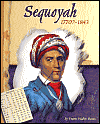
SEQUOYAH

by AMERICAN NATIONAL BIOGRAPHY,
edited by John Garraty,
copyright 1999
by the American Council of Learned Societies.
Used by permission of Oxford University Press, Inc.

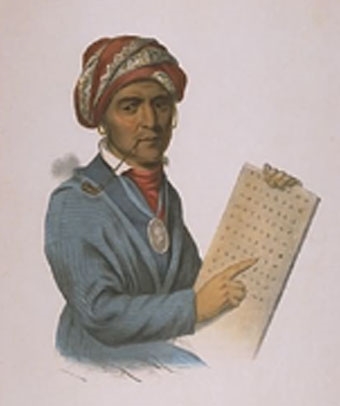
Photo courtesy of Ocmulgee National Monument, National Park Service

Sequoyah (1770?- Aug. 1843?), inventor of the Cherokee syllabary, was born in the Cherokee town of Tuskegee in present-day eastern Tennessee, of uncertain parentage. He married Sally (maiden name unknown) in 1815, and they had four children. According to Emmet Starr's History of the Cherokee Indians (1921), Sequoyah also married U-ti-yu at an unknown date; they had three children. Sometimes referred to as George Guess, or Gist, he was a silversmith by trade, but he had been a warrior. During the Creek War (1813-1814), he enlisted in Colonel Gideon Morgan's Cherokee regiment and served three months.

Accounts of the inspiration for committing Cherokee to writing vary, but Sequoyah revealed to Samuel Lorenzo Knapp in 1827 that his interest stemmed from the capture of a soldier in a late-eighteenth-century campaign. His war party discovered a letter in the soldier's possession, and the warriors debated "whether this mysterious power of the talking leaf was the gift of the Great Spirit to the white man, or the discovery of the white man himself." According to Knapp's account of the conversation, published in his Lectures on American Literature (1827), "Most of his companions were of the former opinion, while [he] as strenuously maintained the latter." He then decided to develop a system for writing the Cherokee language. After many years of work, Sequoyah finally created a symbol for each syllable, and in 1821 he unveiled a syllabary of eighty-six characters (later reduced to eighty-five), which reportedly could be mastered by a Cherokee speaker in several days.

At the time Sequoyah introduced his syllabary, he was living in Arkansas rather than in his native Southeast. Cherokees had acquired land in Arkansas in the early nineteenth century, and following land cessions in 1808-1810 and 1817-1819, several thousand Cherokees had moved west. A signatory to an unpopular land cession in 1816, Sequoyah had moved west in 1818. He returned east, however, soon after his invention and introduced his syllabary to Cherokees still living there. The Sequoyah syllabary became an immediate success, particularly among Cherokees who had no knowledge of English and little exposure to Anglo-American "civilization." The highly acculturated leaders of the Cherokee nation, the political entity in the Southeast of which three-fourths of the Cherokees were citizens, seem to have known little about the grassroots movement toward literacy. As Cherokee Elias Boudinot recalled in an article in American Annals of Education (1 Apr. 1832), by the time they learned of the invention, "the Cherokees had actually become a reading people." By 1835 approximately half of the households in the Cherokee nation had members literate in Cherokee.

Rejecting a rival system for writing Cherokee developed by a white philologist, John Pickering, the Cherokee nation embraced the Sequoyah syllabary and incorporated it into the Cherokee renascence of the 1820s. In 1824 the national council voted to honor Sequoyah with a silver medal. The nation also decided to purchase a printing press and types in Latin letters and the Sequoyah syllabary, and in 1828 the Cherokee Phoenix, a weekly bilingual newspaper with a circulation of about 200 copies, began publication. Missionaries and Christian Cherokees began to translate hymns and the New Testament into Cherokee. In the West, the Arkansas Cherokee signed a treaty in 1828 that provided for their removal to what is today northeastern Oklahoma. The treaty promised Sequoyah $500 as a reward for his achievement and the western Cherokees $1,000 for a press. The federal government fulfilled neither promise to the western Cherokees, and soon it even cut short the Cherokee renascence in the Southeast.

At the insistence of southern states, particularly Georgia, the United States began to pressure the Cherokee nation to move west. Ultimately, an unauthorized minority of Cherokees agreed to a removal treaty, which the U.S. Senate ratified in 1836. By 1839 the dispossessed Cherokees from the East had arrived west of the Mississippi, where they outnumbered their well-established kinsmen, who included Sequoyah. A struggle for power that verged on civil war erupted. Sequoyah broke with his fellow western Cherokees (or "Old Settlers"), who wanted to impose their government on the far more numerous newcomers, and appealed to the Cherokees for a new government that encompassed all. In a letter reprinted in Grant Foreman's Sequoyah, he encouraged the Cherokees to "talk matters over like friends and brothers." His influence helped make possible a compromise that most Cherokees accepted.

In his new role as national conciliator, Sequoyah decided in 1842 to find a group of Cherokees who, according to unsubstantiated reports, were living in Mexico. He died without having located any Cherokee expatriates. The exact place of his death is unknown.

Sequoyah's syllabary remains a source of pride for Cherokees and a medium of cultural preservation. Albert L. Wahrhaftig's survey of four Oklahoma Cherokee communities in 1964-1965 revealed that 36 to 65 percent of adults were literate in Cherokee. Some Cherokees used the syllabary for personal correspondence and gained information through publications in the syllabary, but writing proved most useful in a religious context. While the desire to read the Bible in their own language inspired many Cherokees to learn the Sequoyah syllabary, a writing system also enabled Cherokee medicine men to record their formulas and preserve an ancient religious tradition. These medicine men probably employed writing in such a sacred task because they perceived Sequoyah's accomplishment as mystical rather than mechanical. Whatever the reason, this particular use of the syllabary as well as its continuing viability elevates Sequoyah's invention above mere antiquarian interest to major historical significance.

Written by AMERICAN NATIONAL BIOGRAPHY,
edited by John Garraty,
copyright 1999
by the American Council of Learned Societies.
Used by permission of Oxford University Press, Inc.


RECOMMENDED READING

Sequoyah and the Cherokee Alphabet (Alvin Josephy''s Biography Series of American Indians)

by Robert Cwiklik, T. Lewis, Nancy Furstinger (Editor)

Sequoyah, 1770-1843 (American Indian Biographies)

by Yvonne Wakim Dennis


More Featured Teacher Heroes

Ana Eugenia Posada is a dedicated teacher who provides help and support to children with learning difficulties.Andrew Greene Jr. of Sierra Leone teaches the world
about peace.
Annie Mansfield Sullivan Macy developed new methods for teaching blind and deaf students.Atsuko Shiwaku set up the International Intercultural Mural Exchange Project to promote peaceful coexistence.
Baba Coleman is a drumming teacher who instills self-determination in his students.Barry Guillot is a
middle school teacher
who makes science
come to life through
service-learning.
Barry Kramer empowers students to ask questions and find answers through Learning Circles, a telecollaborative learning experience.Bill Belsey is a teacher with a mission to stop bullying.
Cheikh Darou Seck is an English teacher in Senegal who inspires his students to become MY HERO reporters.Christa McAuliffe 
was the first teacher to fly in space.
Domingo F. Sarmiento was a distinguished educator and president of Argentina.Dr. Ed Gragert works towards peace and global education.
Dr. H. Arief Rahman is admired by his students for the way he speaks his mind and encourages them in their studies.Dr. Norman Isaacs is an inspiration to the staff and students at Millikan Middle School.Dr. Robert Ballard
and the JASON project
 bring scientific exploration to children around the world.
Eeva Reeder is passionate about teamwork and hands-on, real-life applications of abstract mathematical concepts.
Emi Yuliaty 
encourages her students to believe that where there is a will there is a way.
Erin Gruwell is the founder of Freedom Writers and an inspiration to teachers and students around the world.Eva La Mar uses visual learning and communication tools to deepen understanding of geography, geology and local history.Film Festival 2005
Teacher Award
Get a Clue
Carol Anne McGuire
 teaches visually impaired children and founded Rock Our World.
Gary Birch is a compassionate educator and role model to his students.Geeta Malik 
is a media arts educator for The MY HERO Project.
George N. Parks 
inspires his band students to do their best and have fun with music.
Georgiana Munteanu, My English Teacher inspires her students to believe in themselves and to love and respect nature.
Giuseppe Fortunati is a computer teacher from Italy who uses the Internet to promote cultural exchanges.Hero Teachers of a Dyslexic is a personal story that seeks to guide and encourage students who learn differently. Herschel Vaughn 
conducts an after-school program that teaches music, discipline, and friendship.
Jacqueline Melnick is a music teacher.
James Burke 
developed a model of discovery called the Knowledge Web to connect information across space and time.
Jason Wilcox 
was a teacher
at Glenmore Christian Academy.
Jason XV:
Teacher Argonauts
 Eight talented teachers from the US and Bermuda took part in Jason XV: Rainforests at the Crossroads in Panama.
Jesse Thyne was a generous soul with a passion for teaching.
Judy Warner worked to create a public high school for technology.Laurel Schmidt 
encourages her fifth graders to get involved.
Louis Braille 
invented a system of writing and reading used by blind people all over the world.
Luisa Orellana is an English as a second language teacher who inspires her students to reach for their dreams.
Mali Bickley uses technology to help her students connect with their peers around the world to build empathy and tolerance.Marco Torres helps students empower themselves through the mastery of multimedia.Maria Montessori 
developed a new approach to education.
Marsha Goren is much beloved by her students for her genuine commitment to them.
Martha Mecartney is a scientist, engineer and professor committed to helping young women interested in the field of science.Mary Lyon 
established the U.S.'s first college for women.
Mary McLeod Bethune used
education to help
in the fight for racial and gender equality.
Mel Levine 
believes that students who understand their learning styles are better equipped for success.
Mia Siscawati 
teaches people to protect their environment.
Mirian Acosta-Sing piloted a project to provide every student and teacher at Mott Hall School with a laptop.Mrs. Linda Klepper 
has changed the lives of many young children as a second grade teacher.
Mrs. Magdalena Domniteanu is a hero for her patience and ability to inspire her students with a love for learning.
Mrs. Mignosa is a hero to Caitlin because she helps her with her studies after school.Mustapha Louznadji 
is an Algerian educator who leads by example and who brings out the best in his students and colleagues.
Pat Bolanos 
founded Key Learning Community to cultivate multiple intelligences.
Peggy Bryan 
emphasizes teacher support, parental and community involvement in the classroom.
Phil Layne gives encouragement, hope, and a helping hand to his students.Raden Ajeng Kartini  championed education and civil rights for women in Indonesia.Ranald MacDonald was a Native American/Scot wayfarer who helped open up Japan to the West.Randy Randall 
exhibits strength, courage, and integrity to his students.
Robert Moses 
founded The Algebra Project, which is committed to teaching math literacy.
Roberta Guaspari-Tzavaras uses music to inspire children to learn.Rowena Gerber and her students raise money to send Solar Ovens around the world. Ruth Simmons 
is breaking down barriers in the world of higher education.
Ruty Hotzen inspires students from around the world through Talking Kites, iEARN.Sadie Dunn is an inspiring role model as a teacher and great-grandmother.September McGee is an artist and a teacher.Sequoyah invented the Cherokee alphabet, which enabled Cherokees to record their history.
Shannon Arnett impacts her students with her love and excitement for learning. Stephanie Joukoff coaches synchronized swimming and is a hero to Emily.Susan Elizabeth Blow founded the first public kindergarten school in America.Tommie Hamaluba is a teacher in Botswana, Africa working to eradicate malaria.
Tony Bencivenga 
stresses the importance of social and emotional learning experiences.
Valentina Mindoljevic is a science teacher who helped to provide aid to women and child refugees in Croatia.Viola Vaughn founded an organization that supports girls working to achieve academic success in Africa.Wendy Jewell is a passionate MY HERO educator, writer and Learning Circle facilitator.
   
Wendy Milette is a visionary filmmaker and educator.   


Last changed on:9/7/2007 8:43:44 AM