 |
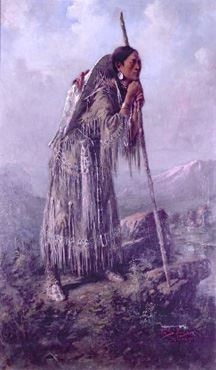
Over two hundred years ago, a Shoshone girl by the name of Bo-I-Naiv (Grass Woman) lived in the northern reaches of the Rocky Mountains, an area now called Idaho. She lived her ordinary life, never knowing that one day she would be a guide for the famous Lewis and Clark Expedition.
The Shoshone tribe lived in constant states of hunger and war; they were defenseless against the other tribes, who by now had guns. One day the Hidatsas, enemies of the Shoshone, captured Bo-I-Naiv and her friends. In the enemies' camp, the Shoshone children made plans to escape; Elk Horn, the oldest and the leader, stole a bow and arrow from a sleeping guard. Bo-I-Naiv could have escaped, but she would not leave her best friend, Otter Woman, behind. Leaping-Fish Woman was also fast asleep. Bo-I-Naiv awakened Otter Woman, who, thinking she was going to be killed, began screaming. By the time their enemies were alerted, all the children had gone, leaving Bo-I-Naiv, Otter Woman, and Leaping-Fish Woman behind.
 |
The girls' master, Red Arrow, kindly treated them like his own daughters. However, Leaping-Fish Woman was not content and escaped. Bo-I-Naiv and Otter Woman despaired for their friend. One day, Red Arrow lost the girls in a gamble to Toussaint Charbonneau, a middle-aged French trader. Red Arrow tried to win them back, but Charbonneau refused. The girls were taken away to live among the Mandans. Charbonneau already had a Mandan wife whose health was poor. Bo-I Naiv was then called Tsakakawea, which means Bird Woman. When Charbonneau's Mandan wife died, he took Tsakakawea and Otter Woman as his wives.
At that time, President Thomas Jefferson was hoping to find a passable water route across the continent to the Pacific Ocean. He sent Meriwether Lewis and William Clark to explore the territory in the north recently purchased from France. The crew consisted of military men, several French interpreters, a servant named York, and Lewis' black Newfoundland dog.
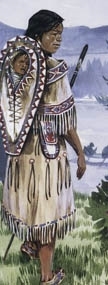
Lewis and Clark found Charbonneau living in the Rocky Mountains and hired him as an interpreter. Charbonneau could only speak French and Hidatsa and, therefore, relied on Tsakakawea to translate the other Indian languages for him. Tsakakawea had her first son, Baptiste, shortly before the westward journey. At age sixteen, with the newborn in a papoose cradle over her back, Tsakakawea embarked on what would be a two-year journey through unfriendly weather and rapid waters.
When the men were hungry, Tsakakawea dug roots and caught little animals for the men to eat. Her presence ensured the white men's safety for other reasons. The white men relied on Indians for food and replacement horses to carry supplies, which meant being able to approach the Indians without being mistaken for a war party. The Indians knew that the white men were not malevolent when they saw Tsakakawea and her baby. They assumed that a war party would never travel with a family.
Tsakakawea's services did not go unappreciated. When a high wind hit the boat she was riding in, she saved many important papers and medicine supplies. Her ability to help in times of crisis earned the respect of the captains. As a token of their gratitude, they named a river after her.
When Lewis and Clark found the Shoshone tribe, they asked Tsakakawea to accompany them as an interpreter. As the Chief spoke, she realized it was her brother, Chief Cameahwait or Black Bow, whom she had not seen for over four years. She was wild with joy and cried out. The Shoshones had given up hope of seeing Bo-I-Naiv again, calling her Wad-Zi-Wip or Lost Woman. Now she had come back with these white men on canoes. Thus, they called her Bah-Rai-Bo, meaning Water-White-Men Woman. She found that, except for Chief Cameahwait, another brother, Red Eagle, and an orphaned nephew, Bazil, all her family was dead. She was also informed that her childhood friends, including Leaping-Fish Woman, had returned safely after escaping the Hidatsas. The captains, seeing that Tsakakawea was overwhelmed with emotion, postponed the meeting so that she could compose herself.
The white men had approached the Shoshones hoping to buy food and supplies, but the Shoshones were no better off than they. They were so hungry that when one of the men shot an animal, they ate the meat raw with their bare hands. Although Black Bow had promised to assist the white men in their expedition with horses and men, he decided, instead, to send his people on a buffalo hunt.
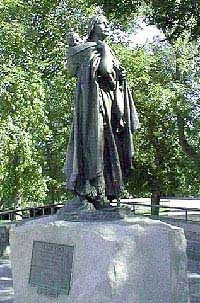 |
| Sacajawea's Statue in Bismark, North Dakota. |
Tsakakawea discovered this breach of promise and found herself facing a dilemma. Keeping the promise meant prolonged hunger for Black Bow's people, while to break it would be the death of the white men. She had to resolve this difficult situation by herself, so first thing in the morning she told her husband to alert the white chiefs, Long Knife (Lewis) and Red Hair (Clark). Charbonneau, who disliked a woman telling him to do anything, dismissed her crucial information as a woman's fancy. Around noon that day, he nonchalantly passed the message to Captain Lewis, after which Lewis hurriedly called for a meeting with the Chief.
The Shoshones must have thought of Tsakakawea as a traitor. Nonetheless, the Chief regretted his treachery and called back his people to help the white men. From this point on, Tsakakawea became more assertive and made her voice known. She had cast her lot with the white people and seemingly betrayed her own people.
When they reached the Pacific Ocean, Tsakakawea saw the massive body of water for the first time. She was scared at first, but soon was walking among the waves. There was a whale carcass stranded on the shore. While the men ecstatically gathered oil from the whale, Tsakakawea stood in awe of the giant creature.
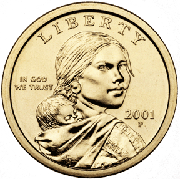 |
| The Golden Dollar Coin, designed by Glenna Goodacre. |
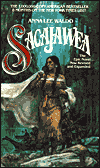
Some reports say Tsakakawea died at age 25 of a fever. Shoshone oral tradition says she returned to her own people and settled at the Wind River Reservation. The tradition is that she died in 1884 (putting her death at about age 106!) and was buried at Wind River. Clark referred to Tsakakawea as Sacagawea in his journals, but during the editing of his journals it was changed to Sacajawea, and this was the spelling etched on monuments dedicated to her. Regardless of whether she died in 1812 or 1884, or what name people called her, she remains a true hero. She was the savior of the Lewis and Clark Expedition and a truly remarkable woman. You can see her featured with her infant on the 2001 Golden Dollar coin designed by artist Glenna Goodacre.
Page created on 7/12/2015 2:30:46 PM
Last edited 1/5/2017 10:27:59 PM
* Anderson, Irving W., "Sacagawea."
* Frazier, Neta Lohnes. Sacajawea: The Girl Nobody Knows. McKay Company, 1967.
* Garamone, Jim. "Sacagawea: Saga of an American Indian Woman."
* Schultz, James Willard. Bird Woman. Cambridge UP, 1918.

Sacajawea helped Meriwether Lewis and William Clark explore the West. Without Sacajawea, the Indians would probably have killed Lewis and Clark. Sacajawea talked to the people of other tribes so that they would let them cross their territory. Sacajawea saved them from many dangers on their trip. In time, they got to the Great Waters (the Pacific Ocean). Without Sacajawea, we might not know about some things in the West that we know now.
Sacajawea is my hero because she showed that girls can do anything, and she proved herself very tough by co-leading a 6-1/2 month, 4,000 mile journey and carrying her infant child along the way.
Click here to listen to the Sacajawea story