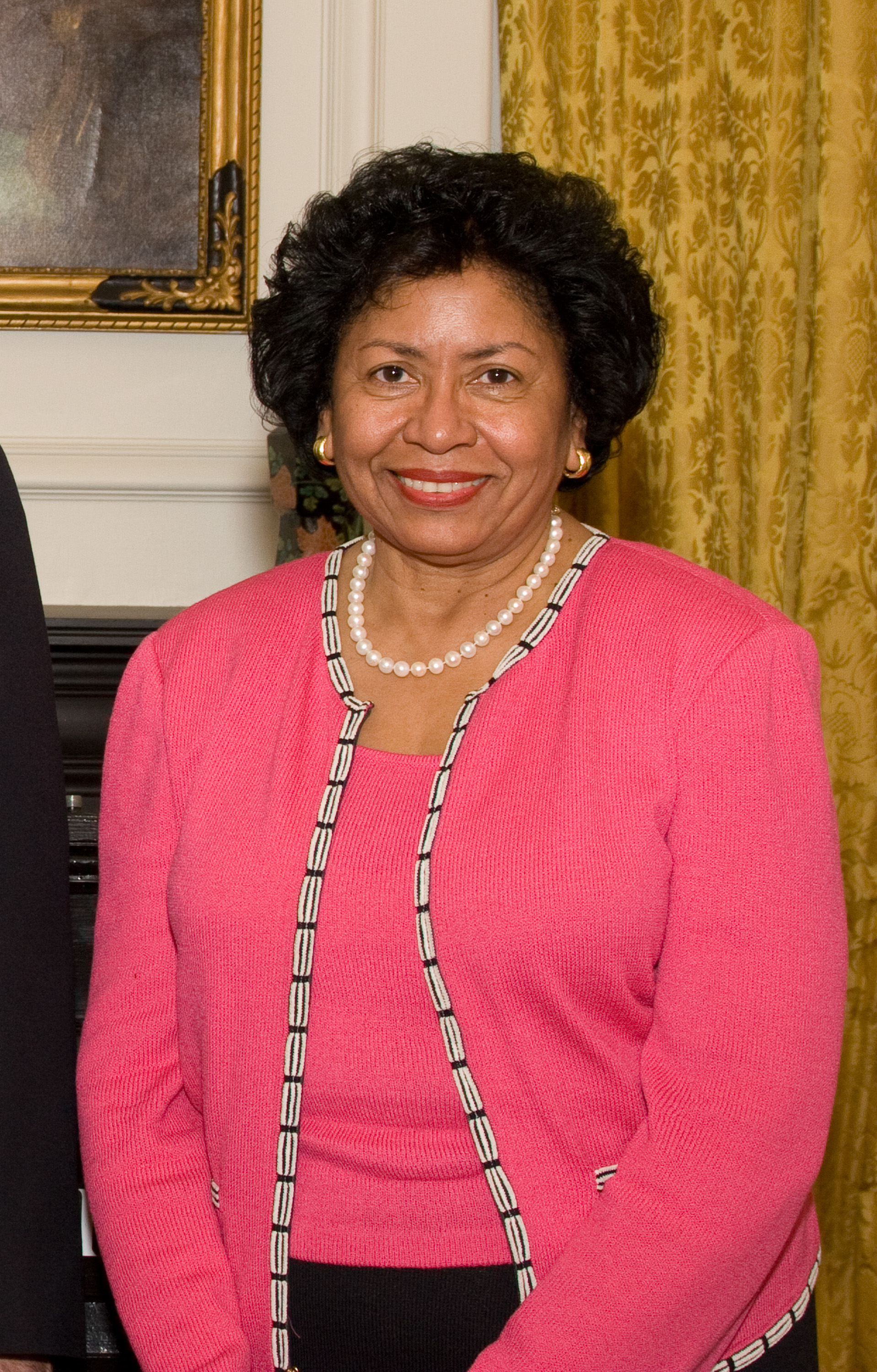
 Ruth Simmons Kenneth C. Zirkel / CC BY-SA via Wikimedia |
Ruth Simmons' great-great-grandparents were slaves. She was the 12th child of sharecroppers and was raised in the community of Grapeland, Texas, during a time of bitter segregation in the South. "The neighborhoods I grew up in were brutally segregated and enforced, of course, by law in the world I grew up in," she wrote. "The boundary between black and white was absolute; the possibility of crossing it was not in my comprehension." Yet during those years, she received some of her most valuable lessons in life. Simmons remembers watching her mother, who worked cleaning houses and doing laundry, ironing "those mountains of clothes...the long tedious process" and her mother's careful attention to all of the details. Her mother insisted on doing the very best job she could moving through the mounds of clothes paying attention to each collar and the details around each button. This simple lesson of doing one's best was one that led Ruth Simmons on her path to success. In July 2001, Ruth Simmons became the 18th President of Brown University and the first black woman to lead an Ivy League institution.
Ruth acknowledges that her mother had the greatest influence on her life even though she did not have a formal education. She taught her children with many stories of those who had faced bigotry with courage. She led by example, facing the daily challenges of life with "grace, magnanimity, and aplomb."
In Grapeland, education was not a priority for the children of sharecroppers. Children often missed school because they were expected to join their parents in the fields during harvest time. It wasn't until Ruth's family moved to Houston that she was able to enter public school. The other children laughed at the way Ruth dressed and spoke. In the face of this difficult transition, her family was a source of strength.
In the years before the Civil Rights marches, when segregation ruled the South, it was not possible for a black child to even think of attending college. No one Ruth Simmons knew had gone to college, especially within her own family, but Ruth set her sights on higher education. Her high school teachers sent her money during her early years in college to help pay for the cost of her education at Dillard University in New Orleans. When she had nothing to wear to college, a teacher took her to her closet and gave her clothes to wear to school. Simmons wrote: "These were people that wanted me to succeed in the worst possible way: they knew the odds out there, and wanted me to overcome them." She graduated summa cum laude in 1967.
As a child, Simmons knew that the segregated society she lived in was not normal. It hurt her when gangs of white boys would pass her in their cars and call her names. She realized that knowledge could strengthen her ability to cope with the "uncivil world." She embraced the humanities. "I studied theater and art and music and mostly literature...because I needed to know the ways mankind had, over the centuries, responded to social change...I needed to understand this because I recognized that if I couldn't come to understand it, I was going to go crazy."
In college, Ruth Simmons learned several languages and traveled to many foreign countries. She thought that by studying other cultures, she might better understand what was happening in her own country. Simmons observed that cultural prejudices in Europe and elsewhere created the same outrageous displays of hatred and bigotry as in the United States.
"We are all flawed," she concludes. "We all face the same great challenge: to try to learn how to overcome the uncivilized instincts that come so naturally to us, instincts to distrust, belittle, and attack anyone who is different."
 Ruth Simmons Jim Wallace / CC BY 2.0 via Flickr |
Years of research and teaching have taught Simmons a great deal about life. However, the lessons learned from her mother as a child are the cornerstone of her faith in humanity. Simmons truly believes that people can overcome the ignorance and mistrust that leads to bigotry and incivility. "We can learn respect for others no matter how different they are from us. We can learn and teach our children as my mother did-how to cherish our individual and collective integrity, even in the face of brutality," she says.
As the President of Brown University, Ruth Simmons will passionately lead this educational institution with great humanity and a vision for a better world. She has instigated a blind admissions policy so that all qualified applicants who are accepted can attend the university regardless of their ability to pay. Simmons embraces Brown University's pioneering spirit and the open curriculum approach to education that places "the burden of choice, freedom, intellectual curiosity and independent motivation" on the student.
Simmons observes that we live in a complex environment in which we are forced to care about people who do not look like us, who do not understand us, who do not eat the same things we eat, who do not believe in the same God. "Can we learn to cross boundaries imposed by cultural, ethnic and religious differences?" she asks. "We owe it to our children and to our children's children to try."
The following section was added by The MY HERO Project in 2025
In 2012, Ruth Simmons retired as President of Brown University. In June 2017, she was made interim President of Prairie View A&M University in Texas, before taking on the role permanently. She was the university’s first female president. On Simmons taking the position, Texas A&M System Chancellor John Sharp said
We are fortunate to have such a high-caliber scholar and administrator who can step in without missing a beat. Dr. Simmons has been an important figure on the national stage for decades. She has the credentials to be the president of any university in America. I am so excited to have her join us.[1]
Simmons remained in the position for five years, during which time donations to the university increased by forty percent.[2] Once she stepped down in 2023, she remained at the university focusing on the university’s research partnerships and fundraising efforts. She also created a program to increase diversity within the university’s leadership.
In 2024, President Joe Biden presented Simmons with the National Humanities Medal, an award given to individuals or organizations that have made significant contributions to humanities in the US. At the awards ceremony in October, Biden said of the honorees,
You all help us find meaning and purpose in the ordinary as well as the extraordinary, providing hope, wisdom, and laughter when we needed it, and we needed a way forward. With absolute courage, you combat racial stereotypes, confront ghosts of history, and speak truth to power.[3]
[1] Prairie View A&M University. Ruth Simmons, Ph.D. Named Interim President of Prairie View A&M University [Online] Available http://www.pvamu.edu/news/2017/06/19/ruth-simmons-ph-d-named-interim-president-of-prairie-view-am-university/. 2017.
[2] McGee, Kate. Outgoing Prairie View A&M President Ruth Simmons will remain at university, create new leadership diversity program [Online] Available https://www.texastribune.org/2022/03/30/prairie-view-A-M-ruth-simmons/. 2022.
[3] Prairie View A&M University. Dr. Ruth J. Simmons awarded National Humanities Medal by President Joe Biden [Online] Available https://www.pvamu.edu/blog/dr-ruth-j-simmons-awarded-national-humanities-medal-by-president-joe-biden/. 2024.
Page created on 2/1/2010 12:16:04 AM
Last edited 6/23/2025 2:39:21 PM
--Ruth Simmons, from her essay "My Mother's Daughter: Lessons I Learned in Civility and Authenticity," Texas Council for the Humanities Journal, Spring-Summer 1998.