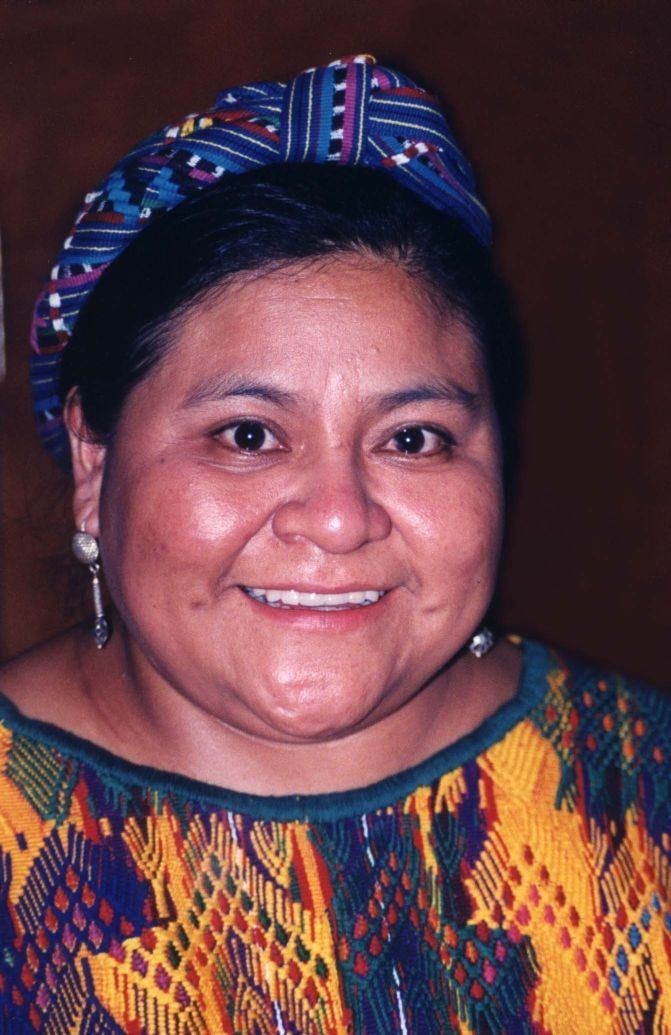
 Rigoberta MenchuKingkongphoto & www.celebrity-photos.com from Laurel Maryland, USA [CC BY-SA (https://creativecommons.org/licenses/by-sa/2.0)]1992 Nobel Peace Prize winner Rigoberta Menchú thinks of herself, first and foremost, as an indigenous woman, even though her Mayan heritage puts her in disadvantage in Guatemala, her home country.
The indigenous people, with their multi-colored Huipils, are the native dwellers of the Americas for thousands of years. European explorers, or conquistadors, came to America in the 15th century, bringing with them diseases and guns. They also exploited the gold found in America to build majestic buildings in Europe. Because of the European explorers, the cultural artifacts of the indigenous people were ruined; their people died of European diseases. The Europeans also married the indigenous people, producing children who were culturally orphaned. Thus, the Europeans almost completely wiped out the indigenous civilization. In Guatemala, the government is made up of Ladinos, one of the various ethnic groups. Indigenous people bore most of the brunt from both the Ladino government and the guerrillas.
Rigoberta Menchú, as so many other indigenous people did, lost members of her family from murders orchestrated by the Ladinos government. Her father, Vincente Menchú, was involved in a protest against the government before the government kidnapped and murdered him. Following the murder of her father, Rigoberta’s mother was raped, tortured and killed. The army also assassinated Rigoberta's brother, Petrocinio.
Rigoberta's family is only another sad example of the Ladinos government's oppression towards indigenous people. Since they are not acknowledged as citizens, they receive no protection from the government, and have to constantly bribe the corrupt government to stay out of jail. The government also intentionally looks for the people’s faults to create lawsuits against them in order to receive bribes. Further, the poor Guatemalans are not entitled to their lands; once they die, the land reverts to the government and not their children.
Menchú became involved with various groups in their struggle for the indigenous people out of personal conviction and sense of justice. Because of her fight against the government, Menchú was labeled an enemy, and had to flee Guatemala for her life. During her time abroad, she met many people who were sympathetic to the indigenous people's plight. Her friends persuaded her to write a book about her life.
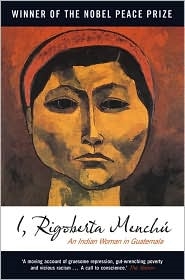
For a week she was interviewed by a French anthropologist who then produced the book I, Rigoberta Menchú. The book won much acclaim from the international society and brought focus to Guatemala. It lifted Menchú's status from an indigenous peasant to a living legend.
When Menchú wrote her book, I, Rigoberta Menchú, the guerrilla movement was at its peak. By the following decade, however, the movement had lost much support becaus the indigenous people did not benefit from the movement and only wanted the fighting to end. The guerrillas and the government soldiers occupied tyrannical positions, and the indigenous people felt caught in the battle between the two hostile groups.
A decade later, Menchú received a surprise call from a friend congratulating her for winning the Nobel Peace Prize. An hour later word came out that she had indeed won the prize, provoking mixed reactions from many sources. Some were glad, since the prize means more exposure for the struggle of indigenous people. Others griped that they never appointed Menchú as their leader and spokesman. She was both the first indigenous person and the youngest person ever to receive the Nobel Peace Prize. People all over Guatemala lit firecrackers, and toasted Menchú, who held a celebration for all her supporters.
Page created on 8/11/2014 4:38:38 PM
Last edited 1/8/2020 9:28:03 PM
Works Consulted
* Menchu, Rigoberta. Crossing Borders. Verso, 1998.
* Stoll, David. Rigoberta Menchu and the Story of All Poor Guatemalans. Westview Press, 1999.
David Stoll's book, Menchú and the Story of All Poor Guatemalans maintains that Menchú dramatized much of her life in her book. However, most of the people whom Stoll interviewed are sympathetic towards Rigoberta and do not care that Menchú dramatized her story. In their minds, she had suffered as many Guatemalans did. In that way, Menchú had become a living icon of all the indigenous people's sufferings. However, the few who had read Menchú's book were enraged by her book.
Even though some people branded Menchú as a liar, the Nobel committee did not cancel her Nobel Prize, and Menchú still has a huge group of supporters. Because of the popularity of her books, people are drawn to the plight of the indigenous people. In the end, though the stories depicted in I, Rigoberta Menchú is not her own true story, it is an epitome of the story of all poor Guatemalans.
A Call for Wise JudgementAfter careful consideration of today's events, I would like to share the following thoughts: 1. I firmly condemn the horrible terrorist attacks that have taken thousands of innocent civilian lives and have provoked an unpredictable spiral of violent consequences. Terrorism, wherever it may come from, is a politically unjustified and morally unacceptable behavior. 2. I express my profound condolences and solidarity with the victims, their families and the American people. 3. I call upon serenity and wise judgment to avoid a rushed and insensate response that could only result in an offensive revenge that only would feed an escalation of violence, that although knowing how and where it begins, nobody could predict when it is going to end. 4. I call upon the use of all available resources leading to a dialogue in order to build a world based on a common understanding, a fair acknowledgement of the problems that the international community faces, the existence of international law and an institutional framework, and the way the existing -selective and unilateral- hegemonic system affects a peaceful cohabitation. 5. I exhort the international community not to fall in a logic of war, seeking retribution for old and new controversies among nations and justifying actions against groups and sectors that have not found a pluralist disposition for the recognition and respect of their individual expressions in the existing institutional frameworks. 6. I call upon the media to avoid alarmist sensationalism based on interpretations of strong ideological bias that only increases the confusion and feeds the ghosts of intolerance. 7. Finally, I call upon the world's civil society, Nobel Prize Laureates, and all world leaders, not to rush to conclusions on today's events conforming instead a wide FRONT FOR WISE JUDGMENT in order to stop the cowardly use of violence and avoid further suffering to humanity. Rigoberta Menchú Tum Nobel Peace Prize Laureate Goodwill Ambassador of the Culture for Peace Mexico City, September 11, 2001 |
Un voto por la corduraLuego de conocer los sucesos que han conmovido al mundo desde las primeras horas de hoy, deseo hacer pública mi posición en los siguientes términos: 1. Condeno firmemente los repudiables actos terroristas que han costado miles de vidas civiles inocentes y han desatado una espiral de violencia de consecuencias imprevisibles. El terrorismo, venga de donde venga, es una conducta políticamente injustificable y moralmente inaceptable. 2. Expreso mi más profundo sentimiento de condolencia y solidaridad con las víctimas, sus familias y el pueblo estadounidense. 3. Hago un llamado a la serenidad y la cordura para evitar responder a la provocación y la insensatez con lo que podría resultar en una ofensiva revanchista que únicamente alimentaría una escalada de violencia que sabiendo cómo y dónde empieza, nadie podría prever cómo ni cuándo terminaría. 4. Invoco a extremar los recursos que hagan posible el diálogo entre un sistema mundial hegemónico, que incluye y excluye selectiva y unilateralmente, y la radicalidad desesperada de las respuestas que ha engendrado. 5. Alerto a la comunidad internacional sobre el peligro de que las acciones de estos grupos terroristas contribuyan a desatar una lógica de guerra, buscando dirimir viejas y nuevas controversias entre naciones y justificando acciones contra grupos y sectores que no han encontrado una disposición pluralista para el reconocimiento y respeto a sus expresiones identitarias en los marcos institucionales actuales. 6. Hago un llamado a los medios de comunicación a evitar el alarmismo fundado en interpretaciones de fuerte filiación ideológica, que sólo acrecienta la confusión y alimenta los fantasmas de la intolerancia. 7. Finalmente, convoco a la sociedad civil del planeta, a los Premios Nobeles y a quienes ostentan la responsabilidad de gobernar todos los países del mundo, a no precipitar conclusiones sobre los acontecimientos de hoy y comprometernos en un gran FRENTE DE LA CORDURA, que detenga la cobarde insensatez de la violencia y evite mayores sufrimientos a la humanidad. Ciudad de México, 11 de septiembre de 2001 Rigoberta Menchú Tum Premio Nobel de la Paz Embajadora de Buena Voluntad de la Cultura de Paz |