 |
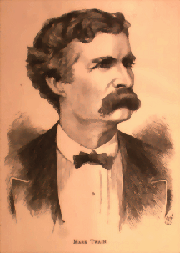
Samuel Clemens was born on November 30, 1835 in Florida, Missouri, the day Halley's Comet, which passes overhead once every seventy-five years, was seen in the sky.
Clemens was a very mischievous boy, especially when he was with his friend, Tom Blankenship. Tom lived in a broken-down farm behind Clemens' house. At night, Tom would give a catcall and Clemens would sneak out to join him. Then they would look for treasure or try to find a cure for warts. During the day they included other friends in their mischief. Once they were rolling boulders down a hill and one just missed a wagon and wagon driver. After that, the boys stopped their mischief.
When Clemens was eleven years old his dad died of pneumonia. He stopped going to school and started working as a typesetter to support his family. A typesetter is a person who sets metal letters called type. This is how newspapers were made. After he became a good typesetter, his brother, Orion, came back from St. Louis where he was also a typesetter. Orion bought a newspaper and made Clemens his assistant. When Orion was out of town, Clemens was in charge. one time when Orion was away, Clemens got people to tell him all the gossip. He printed it in the paper. Everyone liked it except for the people he was talking about. Those people came to complain, including one armed with a shotgun! When Orion got back he quickly put an end to Clemens' mischief.
For fun Clemens liked to write funny short stories and send them to a newspaper. They would get published, so he kept writing. At age seventeen, he went to work as a typesetter for newspapers in St. Louis, New York, Philadelphia, and back in St. Louis. Again, he worked with Orion but this time in Iowa where Orion lived. He then worked in Cincinnati for a while. He gained quite an education working on the newspaper. But after ten years of being a printer he wanted to move on.
 |
At age 21 in 1857 he boarded a steamboat to South America. As soon as he was on the Mississippi River he forgot about going to South America and wanted to become a steamboat pilot. Clemens went up to the pilot and begged him to teach him how to be a steamboat pilot. Mr. Bixby, the pilot, finally accepted at a cost of $500. Clemens was to pay $100 at the start and $400 after he became a pilot. Bixby taught him everything he knew. Later, he was transferred onto another boat called the Pennsylvania. By then his younger brother, Henry, wanted to work on the river too. Clemens arranged for Henry to work on the Pennsylvania. One day the pilot, Tom Brown, started to hurt Henry because of a tiny mistake. Defending his brother, Clemens hit the pilot on the head with a chair, and as punishment got thrown off the boat for the next trip.
Clemens told Henry that, in case of an emergency, he should always help the people into the lifeboats rather than himself. He said, you can always swim across the river. Unfortunately, the boilers overheated and exploded. Henry was thrown far from the boat. Taking his brother's advice, he swam back to the boat, unaware that he was badly injured. He helped people onto the lifeboats as Clemens instructed. Within six days, Henry died in a room with other seriously injured people. From then on, Clemens always blamed himself for his brother's death. Later, Clemens got his license and became an official steamboat pilot, a job he held for about four-and-a-half years. His adventures on the steamboat added flavor to some of his stories such as Life on the Mississippi and The Adventures of Huckleberry Finn.
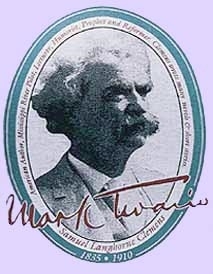 |
Suddenly the country was thrust into the Civil War and steamboat travel became scarce. So, in 1861, Clemens joined a group who were fighting for the South. He was given a mule, a rifle, blankets, a suitcase, a frying pan, a quilt, some rope, boots, and an umbrella. What Clemens learned the most while he was fighting was retreating! Clemens started to write short funny stories and send them to newspapers. Before long, a newspaper called The Daily Territorial, wanted to hire him as editor for $25 a week. He accepted, and left for Virginia City. When he wrote anything serious, he would sign it with his real name, Samuel Clemens. But when he wrote something funny and fictional, he signed it with his pen name, Mark Twain. "Mark Twain" was a call from a river man meaning "safe water" (twelve feet or two fathoms).
He became well known for a series of hoaxes he devised. One of his biggest hoaxes was when he wrote about some miners who uncovered a three-hundred-year-old petrified man thumbing his nose. People all over started making different versions of the story. Most people thought it was true. It was all over magazines and newspapers, and officials started getting angry and threatened to throw Mark Twain in jail. Twain fled the town and went to San Francisco. He worked for a new newspaper called The Morning Call. The honest way he wrote about the government made politicians angry (journalists were supposed to be in their service, after all!) and Twain fled town again. This time he went to Sacramento Valley where he swapped stories with other men. There he heard an ancient Greek tale about a frog jumping contest in 1664. Mark Twain wrote his own version called "The Celebrated Jumping Frog of Calaveras County." It was printed in newspapers all over and Twain soon became known as "The Wild Humorist of the Pacific Slope."
Twain traveled places working for more newspapers and writing lots of stories about his experiences. When Twain was 31 years old he published "Jumping Frog" and other stories in a collection. Then he took a trip to Europe and toured for five months. When he returned in 1867, he wrote a book called Innocents Abroad that was based on his travels.
 |
Some stories that were written by Mark Twain (Samuel Clemens), such as The Adventures of Tom Sawyer and The Adventures of Huckleberry Finn, were actually based on stories of his childhood. Huck was based on Sam's good friend Tom Blankenship and Becky was based on Laura Hawkins, his sweetheart. Tom was based on Twain himself, and Aunt Polly was based on his mother, Jane Clemens. Mark Twain used his experience and knowledge in many of his stories. He used real people and things that really existed and then changed their names.
During his travels, Twain had met Charles Langdon from New York. He showed Twain a portrait of his sister, Olivia. On February 2, 1870, Twain and Olivia got married. They lived in Buffalo for some time, then moved to Connecticut. They built a big house in Hartford. Here Twain lived with his three girls, his dozen cats, and his wife, Olivia.
Lots of Twain's books were published in Hartford but most of them were created near Elmira, New York, on the Langdon's farm. On a hill near the house, they built a study for Twain. It had eight sides that looked like a ship pilot's house on a steamboat. This was where the author worked.
Twain made a lot of money from writing his books, but he lost money by investing in inventions. So he went to England where living was cheaper. He was there for nine years. But then Twain came face to face with a $150,000 debt. So then for a year he went on a worldwide tour giving lectures. He then paid his debts and returned to Connecticut in 1900.
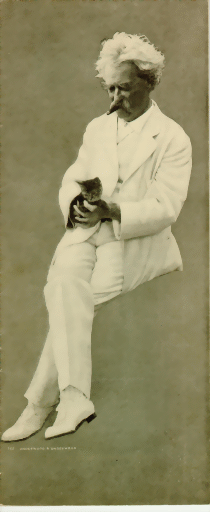
Mark Twain spent his last years in a house in Connecticut. Everyone respected the man who was a river pilot, typesetter, humorist, much loved author, and more! Twain always had a cat around, and, if you were wondering who the favorites were, they were Blatherskite, Apollinaris, Beelzebub, and last but not least, Buffalo Bill.
On April 20, 1910, Halley's comet was seen in the sky. Twain always said that he had come with the comet and would go with it. This was less a joke than a prophecy, for he died on April 21, 1910. After his death, some of his books were translated into many foreign languages, and even though he's not around any more, you can always read his books and keep on laughing!
Page created on 8/18/2014 9:17:17 PM
Last edited 9/15/2018 10:48:55 PM
1. Robert Quackenbush, Mark Twain? What Kind of Name is That?, 1984, Prentice-Hall, Englewood Cliffs, New
Jersey
2. Charles Michael Daugherty, Samuel Clemens, 1970, Thomas Y. Crowell Company, New York
3. Sterling North, Mark Twain and the River, 1961, Houghton Mifflin Company, Boston/The Riverside Press,
Cambridge
4. May McNeer, America's Mark Twain, 1962, Houghton Mifflin Company, Boston/The Riverside Press,
Cambridge
5. Jean Rikhoff, Writing about the Frontier: Mark Twain, 1961, Encyclopedia Britannica, Inc., Chicago
6. Charles Neider, The Complete Short Stories of Mark Twain, 1957, Doubleday & Company, Inc., Garden City,
New York.