 Maria Montessori Unknown author / Public domain via Wikimedia |
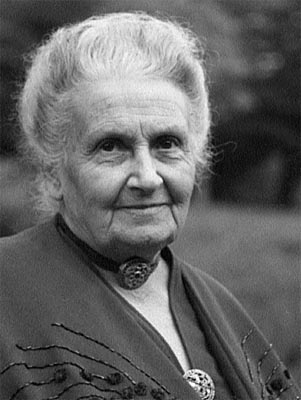
Maria was born in Rome, Italy in 1870 to an upper middle class family. Her parents wanted her to be a housewife, as were most women of her generation, but Maria had other ideas. In 1896, she became the first female doctor in all of Italy. It was very hard for her to become a doctor because all of the other doctors were men. The men made fun of her and threatened her. All she could do was block them out. Because of this, Maria never married.
After that she started working with disabled children. Maria devised a new method of education because she thought the method in place at the time was not serving the needs of the children. She observed that children have developmental periods in which they are primed to learn different things.
Her approach to teaching disabled children was very different than anyone else’s at the time. Instead of the traditional methods that included reading and reciting, she taught the children by using concrete materials, which worked very well. Learning was not memorizing but sensing and experiencing things. The disabled children scored higher on the same test that the regular children took; then she got an idea: “Why can’t normal children benefit from the same method?” So she opened a Casa dei Bambini or Children’s House in the slums of Rome. She moved around Europe for a while until she settled in Italy again after World War II and the fascist government was no longer. Montessori had a big impact on education; because her methods were different, she opened up a new light on the subject.
She died in 1952, but her legacy, with over 150 schools in the US and even more worldwide, lives on.
Children’s House is a Montessori program in which children three to six years old are in one classroom. Montessori developed a system for teaching children differently from the usual way where children sit at fixed desks, listening to lectures. The Montessori method is based on the premise that the child wants to learn, and independence and order are key.
Maria Montessori came up with this method from observing the development of children. She found out children have sensitive periods. From birth through six years is a very crucial time for young children when they must learn independence and order to understand the huge world that is before them.
The teacher is called a directress in the Montessori method because she directs the child. That is, the child has to pick work independently, although the teacher must direct the child so the child cannot do too much of a single thing. That is why we call her a directress.
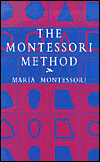
Montessori materials are different from many other materials because these are concrete materials in which the child learns order, such as the Brown Stair and the Pink Tower. These are blocks which differ in two and three dimensions; so they teach how to discriminate size. They are self-correcting; that means the child can see if there is an error instead of the teacher having to come and correct it. There are other materials that teach responsibility, coordination, and independence. Some materials like the sandpaper letters use and develop the sense of touch while teaching how to recognize and write letters and words. Some materials also teach how to take care of oneself.
The Montessori method has been very successful at teaching many children how to take care of themselves, how to write, read, and use countless other skills that people need to survive in today’s world.
The Montessori Elementary classroom is characterized by a prepared environment, which contains concrete learning materials developed by Maria Montessori. Teachers act as guides for the children as they explore the world around them. They direct the students' education by providing a list of things to do, but the children get to choose what to do from that list. The teachers guide the students' natural curiosity.
There are multi-age groups in each classroom. In lower elementary, there are children ages 6-9, and in middle elementary, there are children ages 9-12. The younger children look to the older children as role models and, by helping out, the older children’s knowledge is reinforced.
Subjects similar to traditional schools are covered in Montessori, but the manner in which learning takes place is different. Students use concrete materials to learn academic subjects, such as math. As they progress through the curriculum, they move from these concrete materials to more abstract thought. Materials are presented in both large and small group settings. When material is presented in a large group, it is generalized; in small groups, it is more specific, and students are grouped according to academic level.
Students learn to use research materials such as encyclopedias and relevant books, but they also look to experts to find information. This searching out experts in the community is also accompanied by a developing sense of responsibility for the world around them. Students take responsibility for the care of the classroom as well as do community service. The final goal is that the student becomes aware of his/her cosmic purpose.
 Maria Montessori Unknown author / Public domain via Wikimedia |
Brickton is a Montessori school located in Chicago, Illinois. Brickton was founded in 1986 by a group of parents. Brickton started with one toddler class (two-year olds), three Children’s House classrooms (children aged 3-6), and one class of elementary students in grades 1-6. As of June, 1998, Brickton has grown to two toddler classes, five Children’s House classes, three classes of grades 1-3, and one class of grades 4-6. In the near future, Brickton hopes to have a junior high class (grades 7-8).
The reason the founding parents chose to establish a Montessori school is because they thought Montessori had the best educational environment and materials. Another reason the founding parents chose the Montessori system is that its founder, Maria Montessori, believed that teachers guide the child and help the child to choose work independently according to developmental needs.
All the different programs (Toddler, Children’s House, Grades 1-3 and 9-12) are located in different rooms but do interact together. For example, the older children (Grades 3-6) help children in younger classes. This interaction between the children is the opposite of what is found in a traditional environment. In a traditional environment, the classes only meet during recess, but at Brickton, the older children help the younger children during work time but do not have the same recess time.
In 1996, Brickton became an International Peace site. This was a very significant and important event because Maria Montessori believed the pursuit of peace should be the primary goal of mankind, and this belief is one of the primary foundations of her educational theory and practice. During our Peace Site Dedication, we sang our song “When Peace Comes” and had a parade of flags from around the world (which we had made), and we heard speeches about peace. All of these activities fit with Montessori because you can’t dictate to a child what peace is. You can teach a child what peace is by showing examples of peace and having them experience peace. The importance of peace is always evident in a Montessori environment because one of the first lessons children learn is to solve their problems with words, not with fighting, which is peace.
Andrew: “I’ve been in Montessori since I was two years old. Montessori education gives children a chance to express themselves while having fun and learning.”Christopher: “I’ve also been in Montessori since I was two years. The best thing about learning in a Montessori environment is that you get to choose what you want to work on and you can work on it as fast as you want.”
Nick: “I’ve been in Montessori since I was three years old. I think the best thing about learning in a Montessori environment is the variety of work in the classroom.”
Michael: “I came to Montessori when I was 3 ½ years old. Montessori was good for me because I am gifted and I need to be able to work at a faster pace.”
Page created on 7/23/2006 11:29:25 AM
Last edited 6/7/2026 10:40:27 PM
"The real teachers of the Montessori method are the children themselves."
"Looking becomes Reading. Touching becomes writing."
An excerpt from Mammolina: A Story About Maria Montessori":
By 1949 Maria had lived through two World Wars, and she spoke often of her hopes for lasting world peace. "We cannot achieve world harmony simply by attempting to unite all these adult people who are so different," she said, "but we can achieve it as we begin with the child who is not born with racial prejudices."