 |
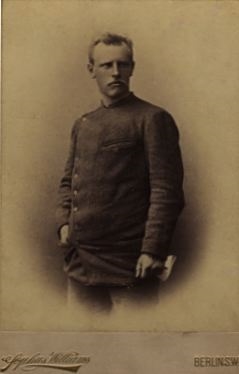
| A Portrait of Nansen from: http://www.nb.no/baser/nansen/english.html
|
A hero is someone who dares to do what is different, strives to help others when no one else does, and gives up what they want for what others need. A hero is a person who stands up for what they believe, always has an open heart, and never judges on first appearances. A hero is not conceited or vain, they are humble and meek. This is a lot for one person to possess -- but it is not impossible to be a hero.
Fritdjof Nansen was born in October, 1861, to a wealthy Norwegian family in Store Frøen. When he was growing up, his parents instilled in him the value of discipline. He dreamed of being a scientist and discovering things and had a yearning to go on adventures. He started college at the University of Oslo in 1881 and decided to major in Zoology.
On July 17, 1888, he began a mission no one thought possible. He went on to be the first man to ski across the Greenland ice cap. Everyone figured he would die, but being a daring person, he dared to do what was different and dangerous. By doing it he made a name for himself in Norway. But that’s not where his exploration ends. In, 1879, an American ship called Jeanette was broken up near northern Siberia. Pieces of the same ship were later discovered off the coast of Greenland. Nansen believed that they had followed an Arctic current that flowed from Siberia to the North Pole and then to Greenland. He was determined to prove this so he built the FRAM, a ship so big and heavy that it could withstand the rough, cold waters of the Arctic. The plan was to sail the ship to where the American ship had been and let it follow the currents.
It took such a long time that Nansen decided to get off for a little while and search for the North Pole. The pole search was a failure, but the Fram was a success. The success was a huge hit in the new field of oceanography; it opened a whole new area for exploration and knowledge.
Though it seems that Nansen could be a hero for his scientific discoveries alone, he also did much more. He saved millions of lives and helped many people find homes when others turned their backs. Nansen returned home from his adventures to find his country, Norway, in distress. They had been ruled by Sweden and the conflict was getting worse. Sweden refused to give the Norwegians freedom. Nansen fought hard and eventually helped to win the people their freedom.
When America joined World War I they cut of most of the exports to Norway leaving the people without very much food. Nansen took a stand and tried to get America to give his country food. When they were slow about it, he took matters into his own hands and directed food into his country. When Nansen returned home from his journeys he had hoped to live the rest of his life in scientific exploration and discoveries. But he was called to help his country so when his duties were over, he again hoped to settle back down. Things were not to go as he wanted.
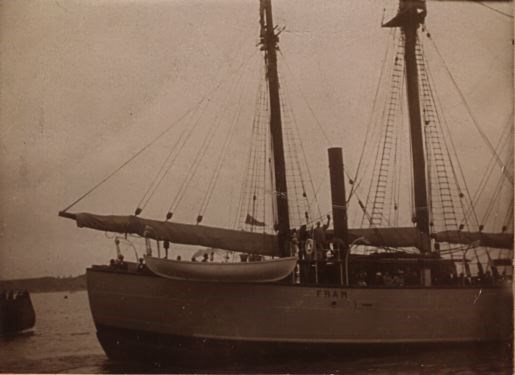 |
| The Fram: from:http://www.nb.no/baser/nansen_eng/english.html
|
Nansen is a hero to me because he stands like a light telling me that if you dare to do what you want and try new things you can accomplish them. He sets an example of putting others before yourself and he shows that service is a wonderful thing. Not only does he show these wonderful traits, but also Nansen has affected me in an even more personal way. My great-grandmother was one of the many Russians that fled the revolution and as I think about it, if Nansen had chosen to go back home and be a scientist, I wouldn’t be here today.
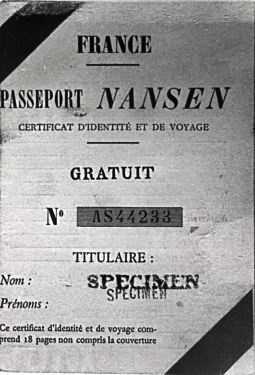 |
| The Nansen Passport: from http://www.nb.no/baser/nansen/english.html
|
The League of Nations wanted to send Nansen over to help the Russian refugees and prisoners of war that were suffering after the war. The Soviet Union did not recognize the League of Nations, but Nansen was a respected person so they agreed to negotiate with him. He helped over 400,000 people.
The International Committee of the Red Cross asked Nansen once more to help the Russians when a crop failure brought famine to 20 million people. He could have refused, but his pity for the people stopped him and he once again gave his services. He asked for help from the League of Nations, but they refused him and because of that many people died. He was not a man that was used to failing, but there was nothing he could do. Then something else came up; many Russian refugees that had fled the revolution and counter-revolution were being pushed around with no homes. Other countries refused to recognize the Soviet Union and the people had no place to go. Yet again the League of Nations asked Nansen to act as High Commissioner for Refugees and organize relief for the people.
He did more than just give them relief; he gave them the Nansen Passport. This gave the people identification and acted as a passport into other countries. Many countries recognized this passport and allowed the people into their land. He won the 1922 Nobel Peace Prize for his effort in helping the refugees and other people. He gave all the money away to help international service. From 1925 onward he devoted his life to helping the Armenian people find homes. His plan in aiding the people and raising funds was turned down by the League of Nations. Though he could not help them, they still respected him for his effort. He served others until he died peacefully in his sleep -- and peace he deserved because he had given it to so many others.
Nansen proved by his actions his many heroic qualities, beginning with his exploration of Greenland and also with the Fram. Many thought he could not do it and thought him crazy for trying. But he still dared to be different and take risks, to show that when you put your mind to something it can be done.
By standing with his country and fighting for freedom from Sweden and successfully securing food during hard times, he shows that you can change things by taking matters into your own hands. This really sets an example for people that are scared to go and do great things and stand up for things that they believe.
These are all really great things but his real heroic traits come in when he gives up his wants to help others. This is one of the hardest things to do. To give up what you love and what you want to do to help others. Yes, at first he was pushed into by the League of Nations, but he could have said no and he could have left as soon as that problem was solved. He had been hoping to live the rest of his life in science, but when the Russians and other nations needed him he didn’t turn his back. This is selflessness and sacrifice in the purest form of the meaning; he gave up what he most wanted to do so that others could live. Even when he had done what the League of Nations asked him to do he stayed on to help during the famine.
Twice when he was offering his help to people the League of Nations refused to listen or support him. He kept on trying to help on his own even without support. This shows that he was not in it for a good name or fame. Many people don’t even no who he is or what he did. But he was in it because he wanted to help the people. Sure, he won a great prize, but he gave all the money away. He gave his whole life up just to help others and even in his final years he was still helping.
Page created on 8/4/2004 12:00:00 AM
Last edited 9/8/2018 4:14:21 AM