Print-Friendly Version


MY HERO: Extraordinary People on the Heroes Who Inspire Them is a collection of essays written by some of the most remarkable people of our time, including Elie Wiesel who wrote an essay on the Concept of Heroes. The authors have contributed their stories to this book to help support this award-winning not-for-profit web project.

"Indifference...is more dangerous than anger and hatred."

PEACEMAKER HERO:
ELIE WIESEL

by Mindy from Millersville

In his lifetime, Elie Wiesel has had to deal with many hardships. The most harrowing was the loss of his mother, father and sister in a concentration camp during the Holocaust. He has written about his horrifying Holocaust experiences in a way that is very educational and beneficial to our society. Wiesel wrote about this in order that such a massacre, which singled out minorities for systematic persecution, would never happen again.
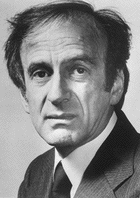
ELIE WIESEL. Photo courtesy of the Nobel Foundation Web site
Wiesel has written many books about the events that occurred in a way that makes you actually feel like you are right there with him. He has said that he "speaks out on behalf of Holocaust victims because he feels it is the right thing to do so that young people can work toward a more humane world--a world in which compassion for those from cultures other than their own is a major priority."

Wiesel is my hero because he has dedicated his life to being a great humanitarian. He teaches us to never forget our past and the horrible experience that he and millions of other individuals endured during the Holocaust. He served as chairman of "The President's Commission on the Holocaust." In 1986, he won the Nobel Peace Prize.

In 1999, Wiesel gave a speech entitled, "The Perils of Indifference." Here is an exerpt:

We are on the threshold of a new century, a new millennium. What will the legacy of this vanishing century be? How will it be remembered in the new millennium? Surely it will be judged, and judged severely, in both moral and metaphysical terms. These failures have cast a dark shadow over humanity: two World Wars, countless civil wars, the senseless chain of assassinations -- Gandhi, the Kennedys, Martin Luther King, Sadat, Rabin -- bloodbaths in Cambodia and Nigeria, India and Pakistan, Ireland and Rwanda, Eritrea and Ethiopia, Sarajevo and Kosovo; the inhumanity in the gulag and the tragedy of Hiroshima. And, on a different level, of course, Auschwitz and Treblinka. So much violence, so much indifference.

What is indifference? Etymologically, the word means "no difference." A strange and unnatural state in which the lines blur between light and darkness, dusk and dawn, crime and punishment, cruelty and compassion, good and evil.

What are its courses and inescapable consequences? Is it a philosophy? Is there a philosophy of indifference conceivable? Can one possibly view indifference as a virtue? Is it necessary at times to practice it simply to keep one's sanity, live normally, enjoy a fine meal and a glass of wine, as the world around us experiences harrowing upheavals?

Of course, indifference can be tempting -- more than that, seductive. It is so much easier to look away from victims. It is so much easier to avoid such rude interruptions to our work, our dreams, our hopes. It is, after all, awkward, troublesome, to be involved in another person's pain and despair. Yet, for the person who is indifferent, his or her neighbor are of no consequence. And, therefore, their lives are meaningless. Their hidden or even visible anguish is of no interest. Indifference reduces the other to an abstraction.

Over there, behind the black gates of Auschwitz, the most tragic of all prisoners were the "Muselmanner," as they were called. Wrapped in their torn blankets, they would sit or lie on the ground, staring vacantly into space, unaware of who or where they were, strangers to their surroundings. They no longer felt pain, hunger, thirst. They feared nothing. They felt nothing. They were dead and did not know it.

Rooted in our tradition, some of us felt that to be abandoned by humanity then was not the ultimate. We felt that to be abandoned by God was worse than to be punished by Him. Better an unjust God than an indifferent one. For us to be ignored by God was a harsher punishment than to be a victim of His anger. Man can live far from God -- not outside God. God is wherever we are. Even in suffering? Even in suffering.

In a way, to be indifferent to that suffering is what makes the human being inhuman. Indifference, after all, is more dangerous than anger and hatred. Anger can at times be creative. One writes a great poem, a great symphony, one does something special for the sake of humanity because one is angry at the injustice that one witnesses. But indifference is never creative. Even hatred at times may elicit a response. You fight it. You denounce it. You disarm it. Indifference elicits no response. Indifference is not a response.

Indifference is not a beginning, it is an end. And, therefore, indifference is always the friend of the enemy, for it benefits the aggressor -- never his victim, whose pain is magnified when he or she feels forgotten. The political prisoner in his cell, the hungry children, the homeless refugees -- not to respond to their plight, not to relieve their solitude by offering them a spark of hope is to exile them from human memory. And in denying their humanity we betray our own.

Indifference, then, is not only a sin, it is a punishment. And this is one of the most important lessons of this outgoing century's wide-ranging experiments in good and evil.


Written by Mindy from Millersville
Photos courtesy of The Nobel Foundation Web site


RELATED LINKS

Academy of Achievement Read an interview with Elie Wiesel. The Academy of Achievement brings students face-to-face with the extraordinary leaders, thinkers and pioneers who have shaped our world.

Teachers Guide for NIGHT by Elie Wiesel

United States Holocaust Museum

Elie Wiesel Nobel Prize for Peace 1986

The Hidden Child Foundation "...to educate all people on the consequences of bigotry and hatred so that never again will anyone suffer the atrocity, the injustice and the agony of the Holocaust."

EXTRA INFORMATION

The Elie Wiesel Foundation for Humanity
529 Fifth Avenue
Suite 1802
New York, NY 10017
212-490-7777


Elie Wiesel contributed his hero story to MY HERO: Extraordinary People on the Heroes Who Inspire Them. Your purchase of this book helps to support this not for profit educational web project.


 
RECOMMENDED READING

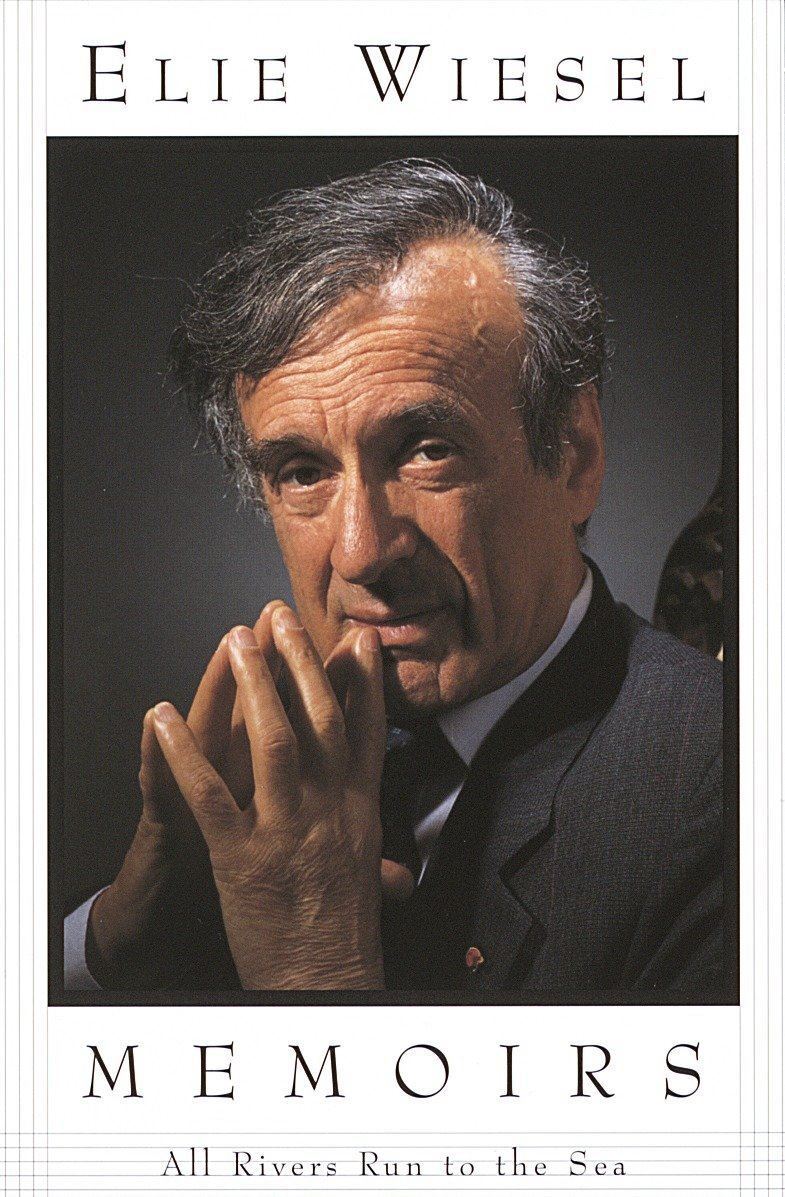
All the Rivers Run to the Sea: Memoirs

by Elie Wiesel

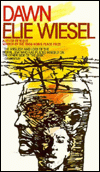
Dawn

by Elie Wiesel, Frances Frenaye (Translator)

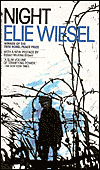
Night

by Elie Wiesel, Stella Rodway (Translator)


More Featured Peacemaker Heroes

Amy Biehl gave her life to ending apartheid in South Africa.Andrei Sakharov was a Russian Nobel Peace Prize winner devoted to justice and human rights.Andrew Greene Jr. of Sierra Leone teaches the world
about peace.
Archbishop Oscar Romero was a passionate voice of hope, peace and justice in war-torn El Salvador.
Ashoka was a fierce warrior-king who changed his ways and became a beloved peacemaker.Atsuko Shiwaku set up the International Intercultural Mural Exchange Project to promote peaceful coexistence.BETTY BIGOMBE was named 'Uganda’s Woman of the Year' in 1994 for her efforts to negotiate peace in Uganda.Chief Arvol
Looking Horse
 appeals to indigenous voices
across the world
to bring peace.
Coalition of Women
for Peace
 aims to make women a key part of the peace process in the Middle East.
Corbin Harney has spread a message
of peace throughout
the world.
Craig Kielburger believes kids can change the world.Dr. Caldicott  has
been a lifelong
anti-nuclear activist.
Dr. Ed Gragert works towards peace and global education.Dr. Fareed Zakaria offers the world a rare perspective on East-West relations.Elie Wiesel wrote the famous Holocaust memoir Night.Elie Wiesel is a Holocaust survivor and author, whose work spreads a message of peace.
Emily Greene Balch received the Nobel Peace Prize in 1946.Florence Kelley was a faithful fighter for child labor laws, women's rights, and civil rights in the U.S.Friends Without Borders is building peace through children's heartfelt letters to one another in India and Pakistan.Gerson Andres Florez Perez was nominated
for the Nobel Peace
Prize at age 16.
Greg Mortenson promotes peace by building schools in Pakistan and Afghanistan.Guernica : Picasso's
work of art evokes
peace worldwide.
Hadraawi, Beloved Peacemaker / Poet
of Somalia
 is a powerful voice for peace in his country.
Hassan 2 was a monarch who worked for peace in the Middle East
Hugo Grotius was a scholar who advocated for peace between nations based on natural law and reason.Ibrahim Alex Bangura makes
music that sends a
message of peace
and tolerance.
Jason Crowe 
received the UN's
Global Peace &
Tolerance Award.
Jehan Sadat is a
leader for peace
and women's
rights in Egypt.
Jimmy Carter has dedicated his life to humanitarian and philanthropic causes.Jimmy Carter 
For as long as she can remember, Sherry Lansing has considered President Carter her hero.
John Wallach helps young people learn to make friends of enemies.Kim Dae-Jung brought democracy and economic stability to South Korea.
Kimmie Weeks survived the war in Liberia and now works to rebuild communities in war-torn countries.Kofi Annan  is an honored freedom and peacemaker hero.Le Ly Hayslip is a humanitarian, memoirist, and powerful peacemaker.Loung Ung 
from Cambodia is a national spokesperson for a landmine-free world.
Lyndon Harris: People Making a Difference founded The Gardens of Forgiveness Project.Malika Sanders was born into the Civil Rights Movement and continues work today.Marc Kielburger is a human rights activist who has dedicated his life to helping others.Martin Luther King, Jr. brought change through non-violence.
Martin Luther King, Jr. was a hero of faith, peace, and tolerance. Mattie Stepanek is
a hero to people
of all ages
around the world.
Mattie Stepanek:
For Our World
 
Mattie’s poems of peace and hope have touched millions of lives
Mohamed Anwar al-Sadat came to be a great advocate for peace.
Mohamed Anwar El Sadat risked his life for peace.Mohamed ElBaradei is dedicated to ridding the world of nuclear weapons.Mohandas K. Gandhi used non-violence to free India from British rule.Muhammad Yunus started a bank for poor people in Bangladesh.
My Hero & Childnet ask
"How can we use the Internet
as a Tool for Peace and Hope?"
 
Nickole Evans is
using technology
for peace.
Oprah was honored by the Elie Wiesel Foundation for Humanity .Oscar Arias Sanchez won a Nobel Peace Prize for his efforts to establish peace in Central America.
Peace Children voted
overwhelmingly for
peace and change.
Peace Palace
International Court Of Justice
 seeks global peace and justice by settling disputes between countries.
Peace Pilgrim walked over 25,000 miles for peace.PeaceJam Foundation 
Students from around the world focus on a Global Call to Action for peace on the anniversary of 9/11.
Postpessimists is working for change
in the Balkans.
Rigoberta Menchu Tum was the first Guatemalan to
receive the Nobel
Peace Prize.
Romeo Alain Dallaire is a celebrated humanitarian for his work during the Rwandan genocide.Ron Kovic has
worked for peace
for over three
decades.
Roshi Bernie Glassman finds
peace in using
Zen to help
others.
Ruty Hotzen inspires students from around the world through Talking Kites, iEARN.Ryuichi Hirokawa photographer who illuminates the needs of children in crisis.Sarah Winnemucca was an advocate for Paiute rights and the first Native American woman to publish a book.
The Art Miles
Mural Project
 
teaches respect
and understanding through art.
The Everest Peace Project 
promotes peace, teamwork, and cultural understanding.
Theodore Roosevelt won the Nobel Prize for Peace for brokering a treaty between Japan and Russia.UWC Initiative for Peace  brings together teens from India and Pakistan to discuss nuclear disarmament.
  
Winston Churchill was one of the first to recognize and warn others of Hitler's danger to freedom and human rights.Yitzhak Rabin made peace a priority as the leader of Israel.  


Last changed on:2/1/2007 8:57:50 AM