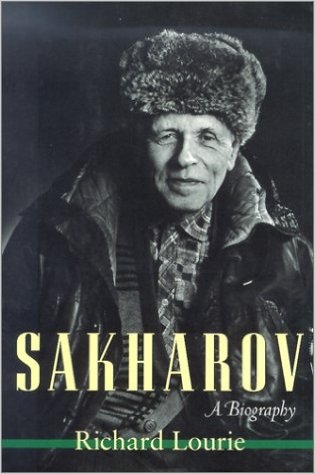
Reprinted with permission from The Andrei Sakharov Foundation. https://sakharovfoundation.org/reading-material/biographies/biography-andrei-dmitrivich-sakharov/
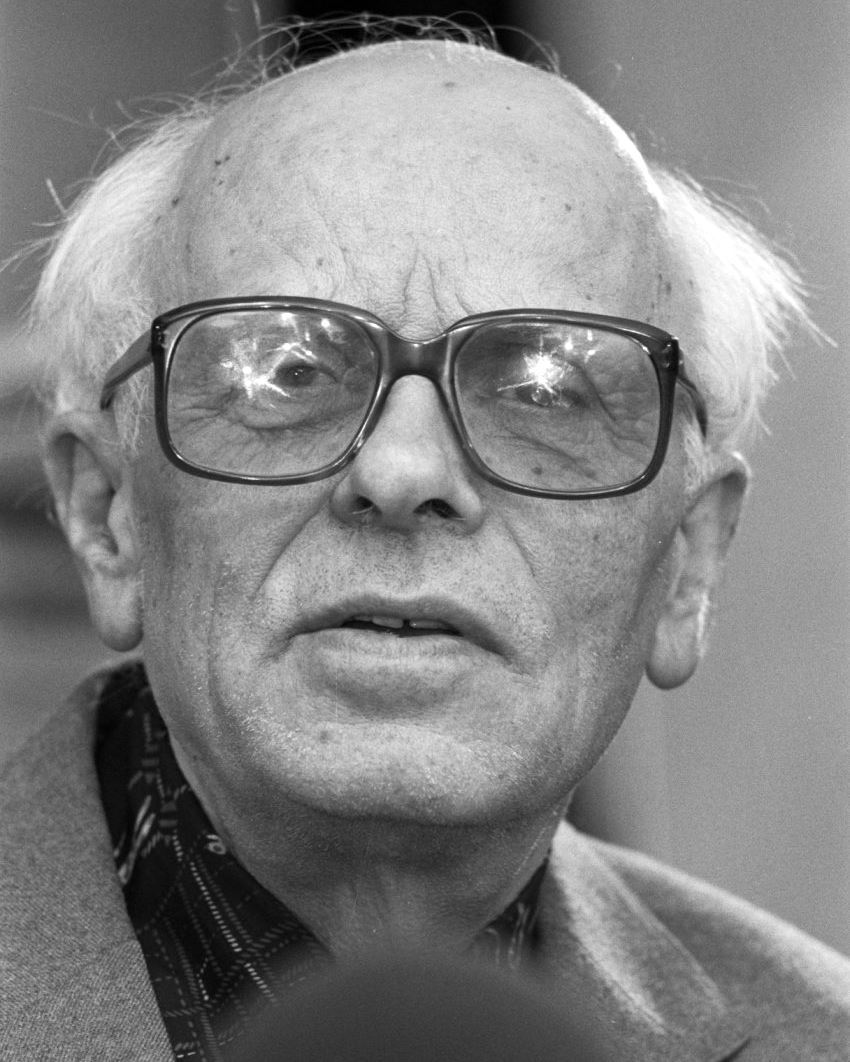 Andrei SakharovAnefo / Croes, R.C., CC0, via Wikimedia CommonsAndrei Sakharov was born on May 21, 1921, into a Moscow family of cultured and liberal intelligentsia. "From childhood, I lived in an atmosphere of decency, mutual help and tact, respect for work, and for the mastery of one's profession." This was, in his own words, the environment that shaped Sakharov's life. At Moscow University where he studied physics, he was quickly recognized as one of the most brilliant students. He was exempted from military service during the war with Nazi Germany and completed his studies in 1942. For several years, he worked as an engineer at an armament factory and patented several inventions. Soon after the war was over, he was recruited into the top-secret nuclear weapons project. He is now universally known as the father of the Soviet hydrogen bomb.
In 1957, his concern with the radioactive hazards of nuclear testing inspired him to write a pioneering article on the effects of low-level radiation. This might be considered his first step towards dissent. In the next 10 years, his concerns took on a more civic tone. He wrote to Khrushchev alerting him to the harm caused to Soviet biology and science in general by Lysenkoism (the primitive teaching whose creator was responsible for physical extermination of many scientists falsely charged with treason in the times of Stalin).
In 1964, together with 24 other prominent intellectuals and artists, he felt compelled to write to Brezhnev, warning him against the rehabilitation of Stalin, planned by Soviet leaders at that time, saying that "people would never understand or accept" Stalin's restoration to a place of honor. It was in 1968, however, that he emerged dramatically in the human-rights struggle and became the movement's inspiration when his essay "Reflection on Progress, Coexistence and Intellectual Freedom" was published in The New York Times. This bold and prophetic essay, a scathing indictment of the Soviet totalitarian system, urged an end to the Cold War and set forth a constructive blueprint for remaking the Soviet Union and the world. Even though the phrase "human rights" was not in this first public statement of Sakharov, the main ideas formed the backbone of what is now universally accepted as the "ideology of human rights," or, more precisely, the "Sakharov doctrine:" the indivisibility of human rights and international security.
Although Sakharov's persistent lobbying achieved significant success in 1963 with the conclusion of the Moscow Limited Test Ban Treaty, for the most part he was frustrated in his attempts to influence the Soviet establishment from within. Publication of his "Reflection on Progress, Coexistence and Intellectual Freedom" abroad led to his firing from the Soviet weapons program. But it was the promotion of this philosophy and his advocacy of human rights as well as the defense of prisoners of conscience, that brought Andrei Sakharov the Nobel Peace Prize of 1975. The Nobel citation called him "the conscience of mankind" and said that he "has fought not only against the abuse of power and violations of human dignity in all its forms, but has in equal vigor fought for the ideal of a state founded on the principle of justice for all." At that time, the Soviet official vilification campaign that was already intensifying against him and his wife called Andrei Sakharov "a Judas" and "laboratory rat of the West." He was denied a visa to go to Norway for the award. His wife, in Italy for eye surgery, traveled to Oslo and read his acceptance speech in which he again stressed the respect for human rights as the key to world stability, progress and peace.
The five years that followed the Nobel Prize brought no improvement of the human rights situation. In fact, there was hardly any doubt left that stagnation in the economy and civic life, as Andrei Sakharov predicted in his 1975 essay "My Country and the World", had finally settled in. In this, and other essays, he continued to develop what would become the intellectual framework for the political, economic, and legal reforms of perestroika. His forceful statements criticizing human rights violations and calling for the release of prisoners of conscience won Sakharov international respect.
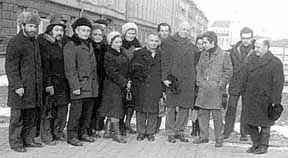 Andrei SakharovSakharov and fellow dissidents, 1975
But at home, in Brezhnev's constricted USSR, the authorities found him exasperating. When Andrei Sakharov denounced the Soviet military intervention in Afghanistan in December 1979, the Kremlin's response was quick. On January 22, 1980, he was banished to Gorky, 250 miles east of Moscow. He was never charged, tried before a court of law, or convicted.
This made total the isolation that had increased steadily over the previous decade, as friends and fellow human-rights activists, as well as family members, were either imprisoned or pressed to leave the country. His wife became his only link to the outside world, serving as his envoy to bring to Moscow and abroad Sakharov's statements on important political issues, among them "The Danger of Thermonuclear War" (Foreign Affairs, Summer 1983), his appeals on behalf of political prisoners, and the major part of his "Memoirs." Sakharov rewrote large portions of his 1,000 page autobiography three times to restore what was stolen by the KGB.
His insistence that his wife be allowed to go to the West for reliable treatment for her heart after she suffered a massive coronary attack compelled him to go on two hunger strikes - in 1984 and 1985. In 1981, Sakharov and Bonner had gone on a hunger strike together for their daughter-in-law, who was denied the right to join her husband, Bonner's son, in the USA. As happened in 1981, Sakharov was forcibly hospitalized and denied any contacts with his wife. Disturbing reports of his death or forced treatments with mind-altering drugs were all the news that came to the West, apart from misinformation, heavily edited and suited for this purpose by the KGB. But his spirit was not broken. In 1985, to impress Western public opinion on the eve of the Geneva summit with Ronald Reagan, Mikhail Gorbachev allowed Bonner to travel to the US, temporarily suspending her sentence to exile in Gorky.
After a successful sextuple heart bypass operation, she returned to her husband and to exile, which continued until Dec. 16, 1986, when a telephone was installed in their apartment and Gorbachev called to invite Sakharov to come back to Moscow and to perform "patriotic work." Back from Gorky, Sakharov moved to fulfill - sometimes reluctantly, sometimes awkwardly, but always with courage and integrity, discernment and compassion - his civic responsibilities as a spokesman for democracy. He was elected to the Presidium of the Academy of Science, and to the Congress of People's Deputies, and appointed a member of the government commission to draft a new Soviet constitution. He served as a national ombudsman, traveling around the Soviet Union to lend his support to persons suffering from official abuse.
In June 1989, at the First Congress of People's Deputies, Sakharov appealed for a radical reformation of the Soviet system and for an end to the Communist Party's dictatorship. Only a few days before his death, he completed a draft of a new constitution for the "Union of Soviet Republics of Europe and Asia."
After his exile, he was a free man for less than three years, but these were the years when the totalitarian colossus began to crumble. Andrei Sakharov witnessed the fall of the Berlin Wall, and the beginning of irreversible changes that swept Russia. He also saw his ideas, his steadfast, uncompromising dedication to truth and justice, shared by thousands of people in his country. In his endeavor to "make good the demands of reason and create a life worthy of ourselves and of the goals we only dimly perceive," he revealed those rare qualities that distinguish genius from talent: the ability to identify the crucial element in complex situations, great originality, and an instinct for the currents of time.
Andrei Sakharov died Dec. 14, 1989, at the age of 68.
Page created on 6/11/2004 6:15:32 PM
Last edited 12/8/2020 11:52:01 PM