|
Lady Augusta Ada Byron, or Ada Lovelace, was an influential force on current computer programming technology. Without her ability to translate theories into clear, readable notes, we may not have been able to interpret the complicated analyses of her colleague, Charles Babbage. A childhood devoted to scholarship and supportive family and friends, all played a significant role in making Lady Byron Lovelace the woman she was.
|
| No one knows what power lies yet undeveloped in that wiry system of mine |
|
During her course of study she received many honors and titles that are still used today. In 1980 the U.S. Department of Defense honored Ada Lovelace by naming their new computer programming language 'Ada.' She was also considered the first computer programmer even though the initial idea was not her own. The works of Babbage would not be recognized today without her writing ability. She depicted writing letters to Babbage in the series The Machine that Changed the World and the letters and writings gathered were compiled to produce Ada, The Enchantress of Numbers: A Selection from the Letters of Lord Bryon’s Daughter and Her Description of the First Computer. Byron's articles "Observations on Mr. Babbage’s Analytic Engine" and her "Notes" appeared in the prestigious journal Taylor’s Scientific Memoirs, under the pseudonym of A.A.L.. These initials provided a safe way for Byron to publish her writings without inviting ridicule. Throughout the world Byron's work is recognized in an array of industries. Organizations in Belgium, France, Germany, Sweden, Switzerland, Spain, United Kingdom, and the United States use the Ada computer program. Ada is also used in many privately-owned industries such as control systems, manufacturing systems, banking and information systems, aviation, satellite and communication, computer-aided design and manufacturing, and even in the entertainment field. The control system, NIF, uses the Integrated Control System (ICCS) architecture. The design is flexible enough to allow the construction of many similar applications from a common framework. A summary that lays the essential foundation for understanding the model-based engineering approach used to execute the design is available at: National Ignition Facility Programs. Manufacturing systems like Enviroplan chose Ada in part because of its "government-friendliness" and in part because its validation had a reputation of enduring formal and rigorous testing. But mostly Ada's multitasking made it the best language for the software, as well as its flexibility, robustness, and ease of change, which proved themselves in two subsequent ports of CEMDAS to new hardware. Other manufacturing systems such as Westinghouse's Czech Nuclear Shutdown System and Weirton Steel Distribution Process Control System are also utilizing the Ada program. The banking system in Sweden automates all payroll, expenditures, deposits, and electronic transactions. Customer information is first collected and inputted into the primary database. The second phase includes the use of actual financial transactions and user accounts. Ada enthusiasts around the world await news of the project's success and can expect to learn that the system, upon its completion, handles 2,000,000 financial transactions per day.” The Local Electric Utility Company uses Ada to cut the processing time by 99.5%. Aviation uses Ada for European air traffic control, airbus 340 flight warning system, Boeing 777, Boeing 777 brake control system, and the Boeing 777 power management system. Satellite and communications systems use the language to develop remote C2 system for PABX Communications (corporate telephone systems for multiple call handling), for the global positioning satellite system, for radio telescope control, and even the mobile communications system (ABB Nera, Satcom, Inmarsat M and Inmarsat B). In computer-aided design and manufacturing "Super-Cad" (system for the heating/ventilation/air conditioning (HVAC) industry), integrated circuits design, vehicle engine test systems, and the Microsoft Windows design-automation all use Ada. In the entertainment industry, this programming language is used to edit videotapes and prompting televisions. One-tenth of the time and cost of budget is used in rocket software which is the primary reason the military uses Ada. Why do so many different industries use Ada? Ada is known as the most correct, safe, reliable, and easily maintainable program application on the market. Ada uses a multi-threading, with the exception of handling, in the OOPL (Object-Oriented Programming Language) on the market today. The worldwide acknowledgement of this program has increased technical support, organizational assistance, and reference manual available to users. The Ada Information Clearinghouse (AdaIC) has been established to provide information about the technical aspects of Ada programming and the syntax involved, and maximize the language's efficiency, cost effectiveness, and productivity. Even though August Ada Bryon (Ada Lovelace) is no longer with us, her creative talents to write with details and exquisite simplicity have continued to grace us even today. Over 35 years after her death, Herman Hollerith (1860-1929) invented a computer that would use a punch card for sorting and tabulating information for the United States Census. In 1931, Vannevar Bush, an American scientist, educator, and administrator, born in Everett, Massachusetts, built the first "modern large analog" computer. The most recent honorable recognition that Ada received was in 1984, over a decade after her death, Ada became a trademark of the United State Department of Defense.
It is a wonder how critical we may be, at times more so than others, about our talents; how unaware we are of our full potential, that August Ada Bryon held so close. If we could be aware of the cruel sentences and limitations we place upon our own strengths and weaknesses, and dismiss them as appropriately as it would be to do so, maybe we, even long after our deaths, could be remembered. Believing, like Ada, that we still have so much to discover within ourselves, we should unleash those binding chains of negative self talk. Lady Lovelace once stated, "No one knows what power lies yet undeveloped in that wiry system of mine." I too believe in me and the potential my mind holds!
|
|
Written by
Sharla D. Walker
from
Lancaster, California
|
|
Intellectual Ammunition Department - Ada Picture Gallery Pictures in relation to Ada and her works. Ada Byron, Lady Lovelace Contributed by Dr. Betty Toole |
|
Biographical information: Ada Byron was born to Anna Isabella Milbanke and George Gordon Noel Bryon, the famous British poet, on December 10, 1815 in London, England. Only a few months after the birth of their first-born daughter, Lady Byron requested a separation from George and received sole custody of their daughter Ada. Less than a year later in 1816, Lord Byron, her father, moved to Switzerland, then Italy; he never returned. Ada grew up thinking that her father never cared for her at all, until later on in life when her mother decided to give her a treasure chest full of items that he had sent her. Terrified that her daughter would grow up to be a poet like her father, Lady Bryon introduced Ada to Augustus DeMorgan, a mathematical genius of his time. During this period of study, she was known to be energetic and extremely talented. She was accomplished in both physical and mental pursuits: gymnastics, dancing, horseback riding, piano, violin, and harp. Her mother once commented that Ada was especially fascinated by the mechanical aspects of things, taking things apart to discover how and why they functioned as they did. As Ada grew older, she was able to take advantage of activities that were only available to the upper class of London, attending concerts, theatre, and elegant parties. Here she met some of the famous people who were later influential to her successes. In 1824, when Ada was eight years old, she received notice that her father had died in Missolonghi, Greece, where he had gone to fight for the independence of Greek from Turkey. When she was 18 years old, Ada Lovelace met Charles Babbage at the home of her math teacher, Mrs. Somerville. Babbage was the mind behind the mathematical engine that she took an interest in. This relationship with Babbage changed her life. She was also an active member of the Bluestockings, a group of young women who would gather periodically to hold literary discussions. These young women would also attend geography lectures at the University of London. At the age of 19 Byron married Sir William King, who would soon become the Earl of Lovelace. The two of them had three beautiful children: Bryon Noel Byron (1836), Anne Isabelle (1837), and Ralph Gordon (1839). After their marriage and birth of the first-born son Bryon, she wrote the first lengthy letter to Sir Babbage and began to attend lectures where the Difference Engine was discussed. After hearing of the wonderful engine that could calculate Bernoulli numbers, she attended many lectures on the Difference Engine by Dionysus Lardner at the Mechanics Institute. She took painstaking notes, which she shared with her friend, Charles Babbage. Charles Babbage once wrote: If you are as fastidious about the acts of your friendship as your are about those of your pen, I much fear I shall equally lose your friendship and your Notes. I am very reluctant to return your admirable and philosophic 'Note A.' Pray do not alter it . . . All this was impossible for you to know by intuition and the more I read your notes the more surprised I am at them and regret not having earlier explored so rich a vein of the noblest metal. Babbage became a part of the family and visited the Lovelaces often. Letters about mechanical devices that would be able to compose musical symphonies and graphics for both personal and scientific use flew back and forth continually. The letters displayed Byron's approbation of Babbage's research, so she invited him to come to their home in January, 1841. Ada later suggested to Babbage that he write out the methods used by the Difference Engine to calculate the numbers; this is now thought of as the first computer program. After writing out the details of Babbage's Analytical Engine, her life was plagued with illness. She would use dangerous combinations of beer, when, brandy, opium and morphine that only contributed to her health problems. During this period of experimental drug and alcohol use, she began to gamble. Even using her acute mathematical skills to devise winning methods of playing, she managed to gamble away her family fortune. Ada died at the age of 36 which, by odd coincidence, was the same age at which her famous father died. |

RECOMMENDED
READING | |
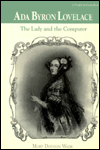
![]() Ada Byron Lovelace: The Lady and the Computer by Mary Dodson Wade |
![]() | ![]() | ![]() | |
| Abner Peeler is credited with the invention of the first airbrush. | Ada Lovelace was a ninteenth century woman who influenced the computer programming of today | Alan Turing laid the theoretical groundwork for the first computer. | Albert Einstein believed in the power of imagination. |
![]() | ![]() | ![]() | |
| Alexander Borodin was an accomplished chemist, composer and staunch advocate of women's rights. | Alexander Graham Bell was the inventor of the telephone. | Ameen Abdulrasool is a young inventor who developed a portable navigation system for the blind. | Amy Charkowski works on the front lines of protecting Earth's food supply. |
![]() | ![]() | ![]() | |
| Andrea Mia Ghez is an astrophysicist best known for her discoveries about the black hole at the center of our galaxy. | Ariel Ruiz i Altaba Scientist - Photographer combines art and science to research how cells are generated and formed. | Audrey Penn: Just Do It is a medical doctor who has devoted herself to studying diseases that affect muscle control. | Augusta Ada Byron developed the world's first computer program while struggling with her own personal hardships. |
![]() | ![]() | ![]() | |
| Babak Darvish, MD inspires his patients and coworkers with his upbeat attitude and determination. | Barbara McClintock was one of the first women geneticists, and a Nobel laureate. | Ben Carson is the chief of neurosurgery at Johns Hopkins University Hospital. | Benjamin Franklin was an inventor, diplomat, writer, and a huge influence on American history. |
![]() | ![]() | ||
| Benjamin Franklin was an inventor, civic leader and founding father of the U.S. | Bernard Fantus created the world's first blood bank. | Bernardo Houssay was an Argentinean physiologist and Nobel Prize winner. | Beth Rickard Environmentalist is an advocate of solar as the energy of the future. |
![]() | ![]() | ![]() | |
| Bill Fenical "Neptune's Medicine Chest" is a pioneer in the hunt for medicines from the ocean to treat cancer and other diseases. | Bonnie Dunbar helped start a scholars program to inspire students to pursue careers in aerospace and engineering. | Charles Darwin is the father of modern biology. | Chiaki Mukai is the first female Japanese astronaut. |
![]() | ![]() | ![]() | |
| Christiane Nusslein-Volhard is a Nobel Prize winner and pioneer genetic researcher. | Claudia Gerwin: Keeping the Neurons Firing researches how nerve cells relay messages to each other. | Clifford V. Johnson is a string theorist who studies the makeup of the smallest particles of the universe. | Connie Samaras has created media archives for deep space voyages. |
![]() | ![]() | ![]() | ![]() |
| Courtney Schumacher is an atmospheric scientist and educator committed to mentoring young women interested in science. | Cristina Diaz: Biologist studies intertidal and tropical sponges. | Dame Cicely Saunders founded the modern hospice to provide compassionate, holistic care to the dying. | DAREnet provides open access to Dutch academic research information and findings. |
![]() | ![]() | ![]() | |
| Darlene Cavalier founded ScienceCheerleader.com to promote science literacy. | Darlene Ketten studies stranded whales and dolphins. | Dean Kamen makes science and technology exciting for young people, | Debbye Turner became Miss America and pursued her dream to become a veterinarian. |
![]() | ![]() | ![]() | |
| Dilfuza Egamberdiyeva cares for the Earth's soil, researching ways to produce microbes to control plant diseases. | Dr Deepak Acharya is a scientist devoted to protecting India's endangered Patalkot Forest. | Dr. Alexander Langmuir Langmuir's work in epidemiology has saved millions of lives. | Dr. Barbara Ross Lee became the first African American woman dean of a US medical school. |
![]() | ![]() | ||
| Dr. Caldicott has been a lifelong anti-nuclear activist. | Dr. Carolyn Mazure founded the Yale Women's Health Program and is a forceful figure in the women's health movement. | Dr. Edward Holland Ophthalmologist transplants corneal stem cells to help give people their sight back. | Dr. Edward Jenner discovered the vaccine. |
![]() | ![]() | ||
| Dr. Elizabeth Kalko and the Jason Project studies bats in the Panamanian rainforest. | Dr. Elvia Niebla Soil Scientist is dedicated to soil conservation. | Dr. Farouk El-Baz is an Egyptian space scientist and geologist. | Dr. France Cordova is a renowned astrophysicist who has broken gender and cultural barriers. |
![]() | ![]() | ||
| Dr. Gloria WilderBrathwaite was inspired to provide health care to the poor in the innner city. | Dr. Govindappa Venkataswamy cares for the eyes of millions of people in India. | Dr. Ines Cifuentes Seismologist works to improve science programs for students in Washington, DC. | Dr. Karen Plaut has been a pioneer in animal science research. |
![]() | ![]() | ![]() | ![]() |
| Dr. Kay Jamison is both an expert on, and a sufferer of, Bipolar Disorder. | Dr. Kristi Curry-Rogers is an accomplished paleontologist who travels the globe in search of dinosaur digs. | Dr. Madan Kataria has started a revolution of joy and laughter that is spreading around the world. | Dr. Michael DeBakey is the father of modern open-heart surgery. |
![]() | ![]() | ![]() | |
| Dr. Patch Adams gives the practice of medicine a humorous twist. | Dr. Richard Murphy Marine Biologist educates others about the sea and ways to protect the oceans for the future. | Dr. Robert Ballard and the JASON project bring scientific exploration to children around the world. | Dr. Rosalie Bertell Anti-Nuclear Nun is a renowned scientist, eco-feminist and peace activist. |
![]() | |||
| Dr. Sara W. Lazar Neuroscientist - Meditator researches the effects of meditation on the brain. | Dr. Sue Savage-Rumbaugh is a scientist dedicated to the study and conservation of bonobos. | Dr. Susan Love is committed to women's health issues. | Dr. Zeda Rosenberg is working to protect women from HIV/AIDS. |
![]() | ![]() | ![]() | |
| Elizabeth Blackwell became the first female doctor and opened the first medical school for women. | Enrico Fermi was one of the 20th century's greatest physicists. | Envirofit retrofits engines to reduce pollution and enhance energy efficiency in developing countries. | Erich Jarvis observes song birds and uses his training with molecular biology to learn about brain behavior. |
![]() | ![]() | ![]() | ![]() |
| F. Sherwood Rowland discovered the 'greenhouse effect.' | Fati Kirakoya is a researcher committed to finding solutions to end HIV/AIDS. | Frederick Banting was the co-discoverer of Insulin. | Friends of the Sea Lion rescue, treat, and release these mammals back into the ocean. |
![]() | ![]() | ![]() | |
| Gail Kaaialii: Biologist investigates the origins of life and helps others value all life forms. | Galileo Galilei was the first to use a telescope to observe the stars and planets. | George Washington Carver is famous for experimenting with plants. | Gertrude B. Elion developed the AIDS drug, AZT. |
![]() | ![]() | ||
| Gina Gallant is an inventor whose passion is protecting the environment. | Grace Murray Hopper was a computer visionary and naval officer. | Guglielmo Marconi was an Italian inventor who won a Nobel Prize in Physics for wireless telegraphy. | Guion S. Bluford, Jr. became the first African-American in space. |
![]() | ![]() | ![]() | |
| Hazel Barton combines her passion for caving with researching microbes. | Hib Vaccine Team created an affordable, synthetic vaccine against the bacteria that can cause meningitis and pneumonia. | Howard Florey shared the Nobel Prize for Medicine for extracting penicillin. | Irene Ayako Uchida helped find the link between radiation and birth defects. |
![]() | ![]() | ![]() | |
| Irene Curie was the second woman in history to win the Nobel Prize in science; the first woman was her mother, Marie. | Jack St. Clair Kilby invented the microchip. | James Burke developed a model of discovery called the Knowledge Web to connect information across space and time. | Jane Mt. Pleasant is an agricultural scientist who looks to the past to meet today's farming needs. |
![]() | |||
| Jonas Salk discovered the polio vaccine. | Kathy Sullivan was the first American woman to walk in space. | Leon Lederman devotes much of his time and energy to improving science education in America. | Leonard Adleman improves lives with his work in DNA technology. |
![]() | ![]() | ![]() | ![]() |
| Leonardo da Vinci was an artist and a scientist ever curious of the world around him. | Leslie Thompson is a scientist devoted to finding a cure for Huntington's Disease. | Louis Pasteur 's discoveries advanced the practice of medicine. | Luz Maria Rodriguez-Fernandez conducts cancer research to help understand the disease process. |
![]() | ![]() | ![]() | ![]() |
| Madame Curie received the Nobel Prize for her discovery of Radium. | Mae Jemison dreamed of going to space since childhood. | Magdalena Hurtado is an anthropologist who studies the Ache people of Paraguay. | Margaret Mead was a renowned anthropologist who thought in terms of 'the interconnection of all aspects of human life.' |
![]() | ![]() | ![]() | ![]() |
| Marie Curie discovered radioactivity as an atomic property, opening the door to 20th century science. | Martha Mecartney is a scientist, engineer and professor committed to helping young women interested in the field of science. | Meenakshi Wadhwa studies meteorites and the processes involved in their formation. | Merieme Chadid is an astronomer from Morocco who did research at the South Pole. |
![]() | ![]() | ||
| Mohammed Bah Abba invented a refrigeration device that is not dependent on electricity. | Neil A. Armstrong was the first man to walk on the moon. | Nikola Tesla was the father of many modern inventions. | Norman Borlaug saved billions of lives with his agricultural discoveries. |
![]() | |||
| Orville and Wilbur Wright were brothers determined to build a better flying machine. | Patrick Nagatani uses photography and colored lights to promote good health. | Paul Farmer has dedicated his life to treating people in the poorest nations in the world | Paul Munsen Solar Oven Man manufactures sun ovens, which harness the sun's rays to provide an environmentally safe source of energy. |
![]() | ![]() | ![]() | |
| Paul Sipiera led an expedition into Antarctica to find meteorites for NASA. | Percy Julian was a groundbreaking African American chemist, inventor, and trailblazer. | Philo T. Farnsworth was the inventor of the television. | Ramani Sankaranarayanan and Geeta Vaidyanathan founded CTxGrEn to show villagers how to turn native materials into fuel for electricity. |
![]() | ![]() | ![]() | ![]() |
| Ray Kurzweil is an inventor who uses technology to restore health. | Reef Ball Foundation restores damaged coral reef systems around the world. | Richard Feynman shared the Nobel Prize in Physics for work in the field of quantum electrodynamics. | Robert Koch was an important medical researcher of the 19th century. |
![]() | ![]() | ![]() | |
| Rokhaya Gueye treats malaria and raises awareness about women's health issues in Senegal. | Saeed Awan developed a new carpet loom that reduces child labor in Pakistan. | Sandra Begay-Campbell is a Native American engineer who brings solar-powered energy to the Navajo reservation. | Shannon Hackett studies the genetic diversity and evolution in tropical birds. |
![]() | ![]() | ![]() | ![]() |
| Sir Alexander Fleming saved millions of lives with his discovery of penicillin. | Srinivasa Ramanujan made groundbreaking contributions to mathematics. | Stephanie Jenouvrier is a population ecologist researching the effects of climate change on emperor penguins. | Stephen Hawking is a renowned theoretical physicist who writes about 'black holes'. |
![]() | ![]() | ![]() | |
| Tania Ruiz is an astrophysicist committed to science education and helping women reach their goals. | Thais Corral gives women a voice in their communities through access to communication technology. | Therese Koutnik is an inspiration to her sister and a role model for girls who would like to become engineers. | Thomas Alva Edison holds the record for number of patents filed. |
![]() | ![]() | ![]() | |
| Thomas Alva Edison is considered one of the world's greatest inventors. | Tim Berners-Lee invented the World Wide Web. | Tom Chau Biomedical Engineer uses science and technology to maximize opportunities for people with disabilities. | Tom Dibblee is a legendary geologic mapper. |
![]() | ![]() | ![]() | |
| Usha Varanasi is the first woman to lead a Fisheries Science Center. | Vint Cerf , Internet pioneer, passionately believes that all people should benefit from the information revolution. | Vladimir Kosma Zworykin is called 'The Father of Television'. | Wes Jackson was a professor who returned to the land to advance sustainable agriculture practices. |
![]() | ![]() | ![]() | |
| Wilson Bentley was the first person to photograph a single snowflake. | XIV Argonauts broadcasted their explorations of the Channel Islands. | Zohra Ben Lakhdar is a physicist from Africa who does research on atomic spectroscopy. |
Last changed on:8/7/2007 7:43:33 AM
|
|