 |
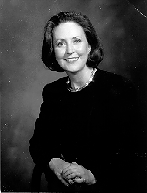
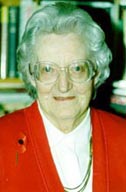
| Ann Armstrong-Dailey, founder of Children's Hospice International |
"She asked me where she could find a hospice program for children. We looked around and discovered, at last, that there were hardly any such programs," recalls Armstrong-Dailey. "That was when I decided to make sure that hospice care for children would become available to anyone who needed it."
The result was Children's Hospice International, a clearinghouse of information on research programs, support groups, and education and training programs that serve children's hospices around the country.
Hospice care, defined as care of people who are very ill and within six months of dying from their illness, involves doing everything to make sure that the patient has as little pain as possible. It is also about providing companionship and comfort during a person's last months or weeks.
Until the 1980s this type of care was not common. People who were very ill and could not be cared for at home usually died in hospitals, surrounded by doctors and nurses too overworked to provide individualized attention to each patient. A hospice is set up to be more comfortable, with the focus on easing the patient's last days rather than attempting to cure the disease.
For twenty years, CHI has been active in setting up hospice care models throughout the United States. The organization also provides technical assistance and implementation materials for hospice programs in over 47 different countries around the world.
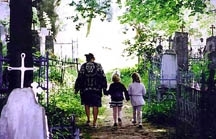 |
| Walking in a Belarusian cemetery. |
Recently, CHI members brought medical aid to Belarusian children battling cancer in the wake of the Chernobyl Nuclear Power Plant disaster. Although the disaster happened in 1986, the children of Belarus are still living in a highly radioactive area and suffer from exposure to radiation. Since that year, incidents of leukemia have doubled and incidents of thyroid cancer increased twenty-four times. CHI facilitated donations of pain medication from pharmaceutical companies, and delivered the medicine to Belarusian hospices.
One of the problems facing children's hospice is the redrawing of old hospice care eligibility guidelines. These guidelines, which were put in place for adults, do not address the needs of sick children. Where adults mostly require hospice in the last six months of life, children need it for a much longer time, generally from the time of diagnosis. Children need what Armstrong-Dailey calls "All-encompassing Care," which means providing hospice-like care from the initial diagnosis (which is generally thought to be the major time of crisis for the families), through curative treatments, and continuing after cure attempts are exhausted. Armstrong-Dailey and CHI are seeking congressional appropriations to fund such a program: the Program for All-encompassing Care for Children and their Families (PACC).
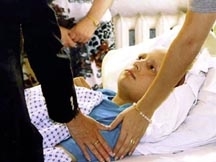 |
| Hospice children receive "all-encompassing care." |
"Congress has been extremely supportive," says Armstrong-Dailey. She adds that interested U.S. citizens might want to write to their Senators and Representatives, asking them to support the PACC initiative. With sufficient funding, Children's Hospice International would get many more children into hospice care programs. Currently over one million children could benefit from hospice care but don't fit the eligibility standards because they are not in the last six months of their illness.
"Getting these children hospice care is one of our priorities," says Armstrong-Dailey. "These children, who fall through the cracks, are the ones we get to know personally, because then we have to go to bat for them. Every child in hospice has this phenomenal wisdom. Every one has an amazing story."
Page created on 6/22/2010 12:00:00 AM
Last edited 6/22/2010 12:00:00 AM
 The following text is from the UCLA Biomedical Library's online exhibit on Pain and Suffering:
The modern hospice movement grew out of the work of British physician Cicely Saunders with dying patients in the late 1940s. Saunders spent more than ten years working toward the opening of St. Christopher's Hospice in London, a facility dedicated to the physical, emotional, and spiritual care of the dying. Hospice spread to the U.S. and other countries, and with it the new field of palliative medicine.
St. Christopher's Hospice opened in 1967 as the first research and teaching hospice. Saunders remembers the dying patient who inspired her in 1947:
"I went to see him, and then I followed him and visited him about twenty-five times during the two months that he was dying in a very busy surgical ward. And he was David Tasma, and he is really the founder of the modern Hospice movement."Hospice substituted pain medication on demand for the time-based dose regimens used in hospitals. Many physicians working with the terminally ill and disabled now argue that medication, including narcotics, should be administered in the amount necessary to provide patient comfort and relief; but others are deterred by the legal restrictions and social stigma attached to narcotic use."When David died, having quietly come back to the faith of his fathers, but not seen a rabbi or anything, he made me his executor and left me this legacy. He said, 'I'll be a window in your home' and it turned out to be five hundred pounds. So that's why we have a commitment from the beginning to openness, openness to the world, openness of course to patients and their families, but openness among ourselves, and I didn't realize all of that to begin with, I just had the rather symbolic picture of a window."
"But two other things he said, or one he said and one I knew about him, were equally important, sort of pillars of Hospice, and the first was, I only want what is in your mind and in your heart. He wanted me to say something to comfort him and I was repeating Psalms, which I knew by heart; and then I said, 'Well, shall I read something to you?' and that's how he used that phrase. But thinking about it afterwards, I realized or began to realize that it could mean everything we could offer of the mind, and that would mean research and constant inquiry and constant learning and increase in understanding, but it had to be given with the friendship of the heart." (From the Oral History of Dame Cicely Saunders, 1993)
In 1996, the American Pain Society made a strong statement regarding Treatment of Pain at the End of Life, arguing that suffering patients would turn less often to assisted suicide if appropriate pain treatment were available to them.
"The greatest fear of the dying and their families is the fear of pain. Sadly, this fear has often been justified. Terminal pain is frequently treated ineptly and the public myth that death from cancer involves unremitting distress is perpetuated. The statement 'I'm waiting for the pain to start' continues to be heard.
"There are many reasons why terminal pain has been so poorly controlled. Until recently, the care of the dying has rarely been included in the training of doctors and nurses. With a few notable exceptions, medical and surgical textbooks have ignored the problems of pain control."
Cicely Saunders. Living with Dying: a Guide to Palliative Care. New York: Oxford University Press, 1995.