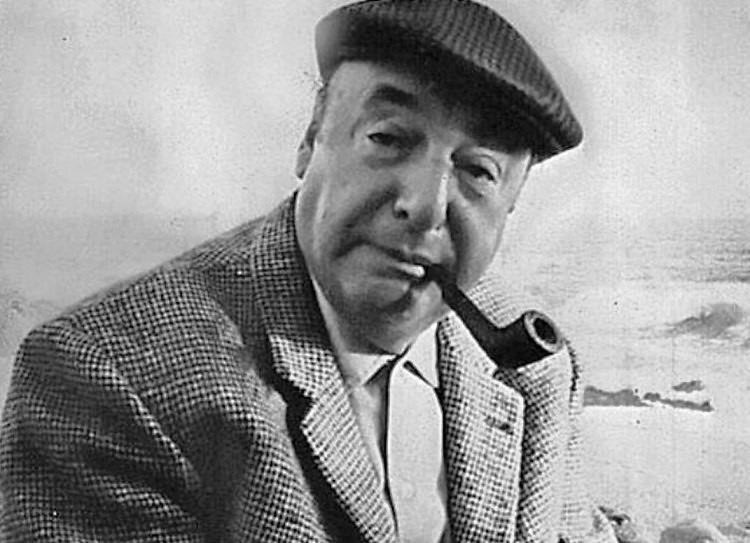
 Pablo NerudaJeso Carneiro / (CC BY-NC 2.0) via FlickrPablo Neruda was born Neftalí Ricardo Reyes Basoalto on July 12th, 1904, in Parral, Chile, South America. His father, Don José Carmen, was a railway worker and his mother, Rosa Basoalto de Reyes, was a schoolteacher. She died of tuberculosis when he was only an infant. Soon after in 1906, he and his father moved to the town of Temuco where his father married Doña Trinidad Candia Malverde. From childhood, he understood the plight of the common man, and the struggle of the working class.
In Temuco, he began to write poems when he was only 10 years old. At the age of 12, he met the Chilean poet Gabriela Mistral, who encouraged his literary efforts. In 1917, he began to contribute to the daily "La Mañana," first with an article titled "Entusiasmo y Perseverancia (Enthusiasm and Perseverance)." In 1918 his poem, “Mis Ojos,” was published in Corre-Vuela. In 1920, at the age of 16, he began contributing to “Selva Austral,” the literary journal, where he first began to use the pen name Pablo Neruda to avoid conflict with his family who disapproved of his literary ambitions. He chose the name as a memorial tribute to the Czechoslovakian poet Jan Neruda, who died in 1891. He used it for over 25 years before finally legally adopting it in 1946. His poems written at the time can be found in his first published book, Crepusculario (1923) which was published when he was only 19.
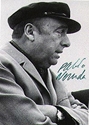
 Pablo NerudaAnnemarie Heinrich / [Public Domain] via WikimediaThe following year he published Veinte Poemas de Amor y una Cancion Desperada (Twenty Love Poems and one Song of Desperation) which is one of his best-known works. In fact, it has sold over a million copies since its first publication.
During the time he also studied French and Education at the Instituto Pedagógico in Santiago.
Even 30 years after his death Pablo Neruda is still considered the most widely read Latin American poet. He is known both for his beautiful love poems as well as for his socio-political ones. From the 1940’s onward, his work reflects the leftist political struggle and the socially historic developments in Chile and South America. It is perhaps that very diversity that has kept his popularity so strong despite the passing generations. He was just as capable of proclaiming his love for a woman with his prose, as he was of proclaiming his political stance.
It was also that very political bluntness that later forced him into exile. A semi-fictional movie was made of it entitled Il Postino in 1995. Its main character, a humble native of an Italian island where Neruda is living while in exile, is moved both by Pablo’s poems of love, as well as by his political daring.
 Young Pablo NerudaRicardo Reyes / [Public Domain] via WikimediaAs the years passed, Neruda became increasingly politically minded. By the age of 23 he was appointed by the Chilean government as Consul to Burma, and following, he held numerous other honorary political consulships, which took him to Europe, East Asia, and throughout South America. During the time he wrote a collection of surrealistic poems titled Residencia en la Tierra published in 1933 and considered to be his “literary breakthrough.” During this time he also befriended the well–known Spanish poet, Federico Garcia Lorca.
Not long after, the Spanish Civil War as well as the murder of Garcia Lorca further fueled his political nature, and he joined the Republican party in Spain, and then in France. There he began work on his España en el Corazón (Spain in My Heart) printed in 1937, which was completed upon his return to his native Chile.
In 1939 he was selected as consul for the Spanish immigration in Paris, where he helped Spanish refugees by resettling them in Chile. He then served as the General Consul in Mexico. It was there that he rewrote his Canto General de Chile, transforming it into an epic poem about the whole of South America. It was published the same year in Mexico, and underground in Chile. Not long after its publication, it was translated into ten languages despite its length -- over 250 poems.
Neruda returned to Chile in 1943 and was elected Senator of the Republic in 1945, at the young age of 41, not long after joining the Communist Party there. In 1947, his protests in print against President González Videla's repressive policy against striking miners forced him to live underground in his own homeland until 1949 when he managed to leave. He fled to Mexico, then the Soviet Union, and then various European countries until his return to Chile in 1952. His 1954 publication, Las Uvas y el Viento (The Grapes and the Wind) is considered the diary of his exile.
But despite his strong political stance, Neruda was not all politics. In fact, his love poems are just as well known as his socio-political ones. He had several widely-known and failed relationships and marriages before marrying his wife, Matilde Urrutia, a Chilean singer, in 1966. His deep love for her became his inspiration for much of his later work, and he dedicated poems to her in his famous Cien Sonetos de Amor (100 Love Sonnets) in 1959.
In 1971, Neruda recieved the Nobel Prize in Literature, becoming Poet Laureate, "for a poetry that with the action of an elemental force brings alive a continent's destiny and dreams."
Neruda died of leukemia in Santiago, Chile on September 23rd, 1973. He left behind a vast legacy of poems and narrative drama, each of which reflect a period in his life. From his love for Communism, to his later coming to question it, and himself, -- to his love for his native land, as well as South America as a whole -- to his love of his wife and of the beauty and grace of women, Neruda was well-rounded, well-versed, and well-respected.
Depending on what book one was to purchase of Neruda’s poems, one could come to see him only as a writer of love poems or as a writer of socio-political ones. I, myself, did not realize for quite some time the prominence politics held in his life. I simply fell in love with Veinte Canciones de Amor and moved around to other love poem compilations until later stumbling across more politically charged ones. It is perhaps that very duplicity that keeps his work so exciting and so vibrant for his readers. His work is extensive, more so than most poets of the modern day, and yet each poem is refreshing, compelling and new.
Page created on 8/11/2014 4:40:05 PM
Last edited 7/8/2020 12:39:09 AM
Haz clic aquí para leer la historia sobre Pablo Neruda en español
Harvey Markowitz writes:
Pablo Neruda has written some great stories about the nature of heroes. I would like to share these two works with the MY HERO visitors:
Heroes
As if I carried them within my anxiety, I find my heroes where I seek them. At first I didn't know how to identify them, but now, wise to life's gambits, I see them pass by arid I have learned to endow them with qualities they do not possess. But I find that I am oppressed by these heroics, and, exhausted, I reject them. Because now I want men who bow their backs to adversity, men who howl at the first lash of the whip, somber heroes who do not know how to laugh, who look on life as a great, dank, gloomy cellar with no ray of sunlight.
But I don't find them now. My anxiety is filled with old heroes, the heroes of old. -- Written By: Pablo Neruda
Goodness
Let us make goodness more stalwart, my friends. Good, too, is the knife that excises the rotten flesh and the worn; and good is the fire burning in the forest, that the good plow might leave the earth.
Let us make goodness more resolute, my friends. Every weakling with weepy eyes and delicate words, every cretin with obscure motives and condescending gestures, wears goodness, awarded by you, like a locked door closed to our examination. We need to call men good who are men of honorable heart, men who are not two-faced, who are humble. See that the word "good" makes itself patty to the vilest complicities, and confess that when you have said "good," it was always-or almost always-a lie. The time has come to stop lying, for, after all, we are responsible only to ourselves, and in private we are consumed with remorse for our falseness, and, as a result, live locked inside ourselves, within the four walls of our astute stupidity. Good men will be those who most swiftly free themselves from this terrible lie and learn to speak out with obstinate goodness against whatever deserves it. Goodness that marches, not with someone, but against someone. Good that does not toady or flatter, but gives its all in the battle, since good is the principal weapon of life. And so, only those who are of honorable heart will be called good, those who are not two-faced, the unbowed, the best. They will vindicate goodness, which is rotting from such baseness; they will be the defenders of life and the rich in spirit. And theirs, only theirs, is the kingdom of earth. -- Written By: Pablo Neruda
I have named you queen.
There are taller ones than you, taller.
There are purer ones than you, purer.
There are lovelier than you, lovelier.
But you are the queen.
When you go through the streets
no one recognizes you.
No one sees your crystal crown,
no one looks at the carpet of red gold
that you tread as you pass,
the nonexistent carpet.
And when you appear
all the rivers sound in my body,
bells shake the sky,
and a hymn fills the world.
Only you and I,
only you and I, my love,
listen to it.

POETRY
And it was at that age...
Poetry arrived
in search of me.
I don't know, I don't know where
it came from,
from winter or a river.
I don't know how or when,
no, they were not voices,
they were not
words, nor silence,
but from a street I was summoned,
from the branches of night,
abruptly from the others,
among violent fires
or returning alone,
there I was without a face
and it touched me.
I did not know what to say,
my mouth
had no way
with names
my eyes were blind,
and something started in my soul,
fever or forgotten wings,
and I made my own way,
deciphering
that fire
and I wrote the first faint line,
faint, without substance,
pure
nonsense,
pure wisdom
of someone who knows nothing,
and suddenly I saw
the heavens
unfastened
and open,
planets,
palpitating planations,
shadow perforated,
riddled
with arrows, fire and flowers,
the winding night, the universe.
And I, infinitesmal being,
drunk with the great starry
void,
likeness, image of
mystery,
I felt myself a pure part
of the abyss,
I wheeled with the stars,
my heart broke free on the open sky.