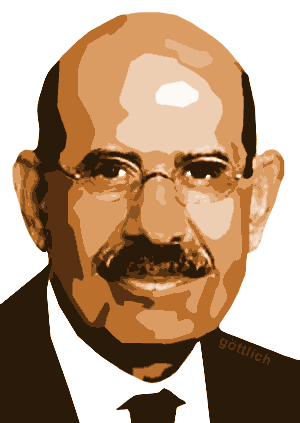
![]() Mohamed ElBaradei doesn’t want to just get rid of nuclear weaponry. He wants to make it something as unthinkable as slavery and genocide and other historical anomalies. In fact, he hopes that soon the only nuclear weapons remaining will be relics in museums, remnants for future generations of unimaginable destruction narrowly averted. Born June 17, 1942 in Egypt, ElBaradei received a bachelor’s degree in law at the University of Cairo in 1962, and later a doctorate in International Law from the New York School of Law in 1974. During his collegiate years he also joined the foreign ministry, serving as the Permanent Missions of Egypt to the United Nations in New York and Geneva. The position, which stationed him in Geneva, put him in charge of legal, political, and arms control issues. Brilliant and energetic, ElBaradei quickly climbed the ranks at the United Nations. In 1984 he became a senior fellow, heading up the international law program at the UN Institute for Training and Research. During this time and for the following few years, he was also an adjunct professor of international law at New York University School of Law. In 1987 ElBaradei became the director of the International Atomic Energy Agency, an inter-governmental organization sponsored by the United Nations. It is in this facet of his career that he is perhaps best known for, and within which, he finds the most personal satisfaction.
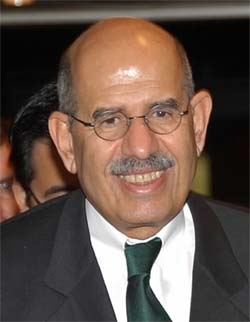
ElBaradei has had to overcome various controversies, including one attempt at ousting him from this position. He has also put life and limb on the line by traveling extensively throughout politically precarious regions including Libya, North Korea, and throughout the Middle East in his fervent attempts to rid the world of nuclear weaponry. Nevertheless, ElBaradei remains realistic and in-tune with international security needs. He is well aware that countries continue to be concerned about their national security, and hence, view these weapons as potential threat deterrents, terrorism deterrents, or as a way to feel on-par security-wise with other nations. He says that today eight or nine countries still possess nuclear weapons, and that there are still 27,000 warheads in existence. He hopes to help rid nations of this type of weaponry by promoting alternative means of security:
“We need to delegitimize the nuclear weapon, and by de-legitimizing... meaning trying to develop a different system of security that does not depend on nuclear deterrence."
Controversy and personal risk aside, ElBaradei’s work has helped exponentially in the reduction of nuclear weaponry and likewise, in international peacekeeping and long-term global safety. In fact, his peacekeeping efforts have become so widely recognized that in 2005 he and the International Atomic Energy Agency were jointly awarded the prestigious Nobel Peace Prize for his “efforts to prevent nuclear energy from being used for military purposes and to ensure that nuclear energy for peaceful purposes is used in the safest possible way." As a further testament to his character, ElBaradei donated his half of the 1.3 million dollar Nobel Prize winnings to the building of orphanages in Cairo. The International Atomic Energy Agency’s (IAEA) winnings are also going to an excellent cause, being spent to train scientists in developing nations to use nuclear technology in ways that can instead benefit humanity, such as in the battle against cancer.
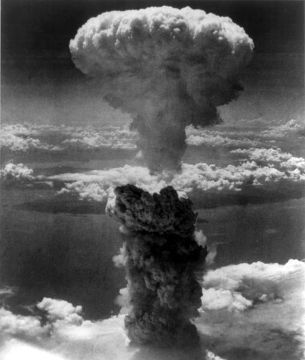
This stance is particularly poignant given that nuclear energy was first intended for the benefit of humanity, not for the creation of potentially catastrophic weaponry. Marie Curie, who herself received two Nobel Prizes, was credited for her tireless work on radioactivity. Her relentless research which eventually poisoned her, resulted in today’s cancer treatments, as well as in modern amenities like computers – but also unfortunately dubbed her the mother of the atomic bomb.
Accordingly, with ElBaradei’s work and the work of the IAEA, the potential benefits of nuclear technology can once again shine through instead of the negative connotations understandably currently associated with it. More importantly, though, when ElBaradei’s work is done, the world can rest assured in the knowledge that weapons that have the potential to destroy entire nations, if not the entire planet, are no longer a threat to humanity, but rather, an unimaginable part of history.
|
|
|
|
The Nobel Peace Prize 2005: Mohamed ElBaradei Biography The International Atomic Energy Agency works with its Member States and multiple partners worldwide to promote safe, secure and peaceful nuclear technologies. Dr. Mohamed ElBaradei is its Director General. The Chernobyl Children's Project established after a modern-day nuclear disaster, has delivered over $63 million in direct and indirect humanitarian aid to the Chernobyl region. The project aims to restore hope to the people of the Chernobyl-affected region. The Nuclear Age Peace Foundation initiates and supports worldwide efforts to abolish nuclear weapons, to strengthen international law and institutions, and to inspire and empower a new generation of peace leaders. Other heroes working for international nuclear disarmament |
RECOMMENDED
READING | |
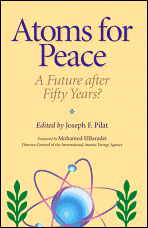
![]() Atoms for Peace: A Future after Fifty Years? by Joseph Pilat, Mohammed ElBaradei, Mohammed Elbaradei (Foreword by) |
![]() | ![]() | ![]() | ![]() |
| Amy Biehl gave her life to ending apartheid in South Africa. | Andrei Sakharov was a Russian Nobel Peace Prize winner devoted to justice and human rights. | Andrew Greene Jr. of Sierra Leone teaches the world about peace. | Archbishop Oscar Romero was a passionate voice of hope, peace and justice in war-torn El Salvador. |
![]() | ![]() | ![]() | |
| Ashoka was a fierce warrior-king who changed his ways and became a beloved peacemaker. | Atsuko Shiwaku set up the International Intercultural Mural Exchange Project to promote peaceful coexistence. | BETTY BIGOMBE was named 'Uganda’s Woman of the Year' in 1994 for her efforts to negotiate peace in Uganda. | Chief Arvol Looking Horse appeals to indigenous voices across the world to bring peace. |
![]() | ![]() | ![]() | ![]() |
| Coalition of Women for Peace aims to make women a key part of the peace process in the Middle East. | Corbin Harney has spread a message of peace throughout the world. | Craig Kielburger believes kids can change the world. | Dr. Caldicott has been a lifelong anti-nuclear activist. |
![]() | ![]() | ![]() | ![]() |
| Dr. Ed Gragert works towards peace and global education. | Dr. Fareed Zakaria offers the world a rare perspective on East-West relations. | Elie Wiesel wrote the famous Holocaust memoir Night. | Elie Wiesel is a Holocaust survivor and author, whose work spreads a message of peace. |
![]() | ![]() | ![]() | ![]() |
| Emily Greene Balch received the Nobel Peace Prize in 1946. | Florence Kelley was a faithful fighter for child labor laws, women's rights, and civil rights in the U.S. | Friends Without Borders is building peace through children's heartfelt letters to one another in India and Pakistan. | Gerson Andres Florez Perez was nominated for the Nobel Peace Prize at age 16. |
![]() | ![]() | ![]() | |
| Greg Mortenson promotes peace by building schools in Pakistan and Afghanistan. | Guernica : Picasso's work of art evokes peace worldwide. | Hadraawi, Beloved Peacemaker / Poet of Somalia is a powerful voice for peace in his country. | Hassan 2 was a monarch who worked for peace in the Middle East |
![]() | ![]() | ![]() | ![]() |
| Hugo Grotius was a scholar who advocated for peace between nations based on natural law and reason. | Ibrahim Alex Bangura makes music that sends a message of peace and tolerance. | Jason Crowe received the UN's Global Peace & Tolerance Award. | Jehan Sadat is a leader for peace and women's rights in Egypt. |
![]() | ![]() | ![]() | |
| Jimmy Carter has dedicated his life to humanitarian and philanthropic causes. | Jimmy Carter For as long as she can remember, Sherry Lansing has considered President Carter her hero. | John Wallach helps young people learn to make friends of enemies. | Kim Dae-Jung brought democracy and economic stability to South Korea. |
![]() | ![]() | ||
| Kimmie Weeks survived the war in Liberia and now works to rebuild communities in war-torn countries. | Kofi Annan is an honored freedom and peacemaker hero. | Le Ly Hayslip is a humanitarian, memoirist, and powerful peacemaker. | Loung Ung from Cambodia is a national spokesperson for a landmine-free world. |
![]() | ![]() | ||
| Lyndon Harris: People Making a Difference founded The Gardens of Forgiveness Project. | Malika Sanders was born into the Civil Rights Movement and continues work today. | Marc Kielburger is a human rights activist who has dedicated his life to helping others. | Martin Luther King, Jr. brought change through non-violence. |
![]() | ![]() | ![]() | ![]() |
| Martin Luther King, Jr. was a hero of faith, peace, and tolerance. | Mattie Stepanek is a hero to people of all ages around the world. | Mattie Stepanek: For Our World Mattie’s poems of peace and hope have touched millions of lives | Mohamed Anwar al-Sadat came to be a great advocate for peace. |
![]() | ![]() | ![]() | ![]() |
| Mohamed Anwar El Sadat risked his life for peace. | Mohamed ElBaradei is dedicated to ridding the world of nuclear weapons. | Mohandas K. Gandhi used non-violence to free India from British rule. | Muhammad Yunus started a bank for poor people in Bangladesh. |
![]() | ![]() | ![]() | |
| My Hero & Childnet ask "How can we use the Internet as a Tool for Peace and Hope?" | Nickole Evans is using technology for peace. | Oprah was honored by the Elie Wiesel Foundation for Humanity . | Oscar Arias Sanchez won a Nobel Peace Prize for his efforts to establish peace in Central America. |
![]() | ![]() | ||
| Peace Children voted overwhelmingly for peace and change. | Peace Palace International Court Of Justice seeks global peace and justice by settling disputes between countries. | Peace Pilgrim walked over 25,000 miles for peace. | PeaceJam Foundation Students from around the world focus on a Global Call to Action for peace on the anniversary of 9/11. |
![]() | ![]() | ![]() | ![]() |
| Postpessimists is working for change in the Balkans. | Rigoberta Menchu Tum was the first Guatemalan to receive the Nobel Peace Prize. | Romeo Alain Dallaire is a celebrated humanitarian for his work during the Rwandan genocide. | Ron Kovic has worked for peace for over three decades. |
![]() | ![]() | ||
| Roshi Bernie Glassman finds peace in using Zen to help others. | Ruty Hotzen inspires students from around the world through Talking Kites, iEARN. | Ryuichi Hirokawa photographer who illuminates the needs of children in crisis. | Sarah Winnemucca was an advocate for Paiute rights and the first Native American woman to publish a book. |
![]() | ![]() | ![]() | |
| The Art Miles Mural Project teaches respect and understanding through art. | The Everest Peace Project promotes peace, teamwork, and cultural understanding. | Theodore Roosevelt won the Nobel Prize for Peace for brokering a treaty between Japan and Russia. | UWC Initiative for Peace brings together teens from India and Pakistan to discuss nuclear disarmament. |
![]() | ![]() | ||
| Winston Churchill was one of the first to recognize and warn others of Hitler's danger to freedom and human rights. | Yitzhak Rabin made peace a priority as the leader of Israel. |
Last changed on:7/20/2007 2:04:35 PM
|
|