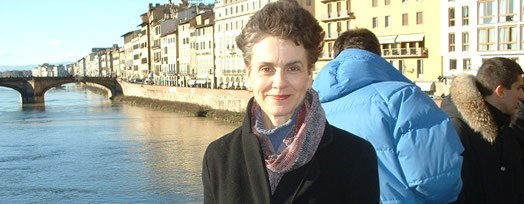
For more than thirty years, activist, advocate, and author Frances Moore Lappe has courageously fought to raise awareness of the ways in which hunger is caused and of the ways in which we can end it. She possesses the kind of optimism and courage it takes to go beyond just pointing out the problem and has been making huge strides to be a part of the solution. Ironically, many of the nations that grow the food that we eat can�t feed their own people. Lappe is a unwavering champion for their cause, striving to solve the problems of hunger and empower all people with the resources and options to relieve these nations� suffering. In the late 1960s Frankie, as Frances Moore Lappe is known by most, was studying food supply at the Berkley college library when she had an epiphany. Spread before her were grain charts, United Nations agricultural tables, a slide rule, and pages of scribblings and equations. All of her calculations led her to one conclusion: that it was possible to feed and nourish every person in the world. Her discovery that year has shaped her life, and has helped to open the eyes of the world on the issues of protecting the planet and feeding ourselves in a healthful, respectful and inclusive manner for all. When Lappe first began sharing her ideas, they were unique and not many people shared her perspective; vegetarianism, the organic movement, nor the health food industry were as strong then as they are today. Even though she knew that she would face criticism and skepticism, Frankie also knew that her ideas could help resolve suffering for millions around the planet; and no amount of intimidation or ridicule would be worth keeping quiet.
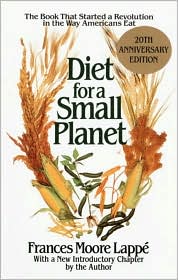
Frances Moore Lappe didn't know that her words would be the ones to open up a movement, but for her, speaking out was worth a try. She believed and continues to believe that anybody can make change; that there is a great deal value in taking action. Nobody knows which person, which voice, which pair of hands, will be the one to push through change, but if every hand does its part to give a little shove, then we will all see the benefits come about. Lappe sees this mutual responsibility within all citizens as a way to end needless suffering from hunger. "Hunger is not caused by a scarcity of food, but by a scarcity of democracy," she argued. ![]() Intent on finding the best way to get the word out and beginning to solve the problem, Lappe wrote a book, entitled Diet for a Small Planet. The book, however, had a slow start gaining popularity, as vegetarianism (and other conscious practices on nutrition, farming, and the environment) was still a radical movement at the time, but she wasn't deterred. Indeed, the book did catch on; since its publication in 1971, Diet for a Small Planet has sold more than three million copies. It launched her on a life journey to create healthier and more efficient ways to nourish people in every pocket of the globe.
Frances feels that the problem of hunger will not be solved from the top down, with governments shipping food to those countries in need. It has to start from the ground, giving people a base to create their own ways of nourishing themselves. With Joseph Collins, she founded Food First in 1975. Still going strong thirty years later, Food First researches the causes of hunger and organizes work to help give the poor a voice, access to land, and the knowledge of ecology and environmentally friendly farming.
All of Frankie's words, work, and activities show that she is not afraid to tell the truth. It is really quite astounding to see how much good can come out of standing up for your values and beliefs�and many others have seen this good come from Lappe. In fact, Artist Robert Shetterly included her in his 2003 portrait exhibition, entitled "Americans Who Tell the Truth." She has also been awarded with many honorary degrees and received numerous honors and distinguishments for her work throughout the global community, among them the Rachel Carson Award (2003) and the Right Livelihood Award (1987), an international award that is often known as the alternative Nobel Prize, for "her vision and work healing our planet and uplifting humanity."
|
|
Written by
Kathy Crockett My Hero Photos courtesy of The Small Planet Institute |
|
The Small Planet Institute Through volunteers and various media outlets, The Small Planet Institute works to encourage the creation of communities that work for all. Democracy's Edge Democracy's Edge, published in 2005, shares inspiring stories of democracy in action. The site tells you more about the book and features encouraging real-life stories of people using their own powers to make communities stronger. Food First Co-founded by Frances Moore Lappe more than 30 years ago, Food First works to "eliminate the injustices that cause hunger." |
|
Read another story about Frances Moore Lappe on myhero.com Read what Frances Moore Lappe has to say in the following excerpts,
Some of the 20th century's most vibrant activist thinkers have been American women--Margaret Mead, Jeanette Rankin, Barbara Ward, Dorothy Day--who took it upon themselves to pump life into basic truths. Frances Moore Lappe is among them. --The Washington Post
My Story...
With the release this fall of Democracy's Edge, I will have traveled a journey of more than three decades. At each stage I've tried to pull away the next layer of causation to grasp the roots of needless suffering. I've wanted to help free myself and others to act on our deep yearning for effectiveness in the world and for solidarity with our fellow humans.
A scarcity of democracy...
But where is this democracy strong enough to end hunger? And what does it look like? Unable to answer, I knew I had to probe more deeply. Believing that solutions did not lie in some new blueprint or dogma handed down from on high, I wanted to engage Americans in thinking through the values that could guide them in finding solutions for themselves. So I wrote Rediscovering America's Values, a dialogue on freedom, the market, democracy, and justice. I hoped the dialogue in this book would trigger thousands of others in homes and church basements across America.
Soon I began to see that a richer, more inclusive practice of democracy was already emerging. But, I realized that it was sadly still invisible to most people and easily reversed. So in 1990 I left Food First to found The Center for Living Democracy in Brattleboro, Vermont. I wanted to help people see that effective democracy--capable of ending hunger and environmental devastation--was more than a particular structure of government. It is a living practice, a vibrant culture of mutual responsibility. In 1994 my book The Quickening of America: Rebuilding Our Nation, Remaking Our Lives (Jossey-Bass) brought this vision to life in real stories across every dimension of American public life.
Knowing that we humans take our cues from each other, I sought to create a democratic "social multiplier" by spreading stories of regular citizens in action. Why not a national news service? In 1995 I became founding editor of The American News Service and over the next five years our terrific staff placed solutions-oriented news stories in more than 300 papers, including almost half of the nation's top 100 newspapers by circulation. Because of ANS, millions of Americans read about people like themselves coming up with creative solutions to problems that ranged from education to race relations to the environment.
Hope in action�
Then in 2000, my children encouraged me to return to my roots, linking all I'd learned about democracy, hunger and the crying need for people to see real examples of hope in action. So my daughter Anna and I traveled on five continents to write Hope's Edge: The Next Diet for a Small Planet, released in 2002. In it, we pick up where the original Diet leaves off. We identify the roots of needless misery in the dominant "mental map" that blinds us to solutions in our own interest. Through the narrative of our journey, readers meet movements of citizens breaking free of this destructive mental map. They show us possibilities for going beyond today's consumerism and the isolation of me-first capitalism to both heal ourselves and our planet.
While writing Hope's Edge, I was a visiting scholar at the Massachusetts Institute of Technology's Department of Urban Studies and Planning, at the Center for Reflective Community Practice. Anna and I were so happy when Jane Goodall called Hope's Edge: "Absolutely one of the most important books as we enter the 21st century."
My current excitement...
I've just completed Democracy's Edge, a sequel to The Quickening of America, to help people fight despair and learn from living democracy emerging in America. Democracy's Edge will be released by Jossey-Bass in November.
Over these 30-plus years I have experienced our world moving rapidly in two directions at once. In one I see heightened violence, polarization, environmental devastation and fear. In this direction lies deepening despair because people now see that thin democracy-- something do to us or for us--cannot solve these problems.
In the other direction, I see Living Democracy emerging. People in all walks of life are rejecting the "daddy politics" of thin democracy. They are taking responsibility, claiming their voices and innovating successes across challenges as diverse as education, economics, criminal justice and food. Their impact is already so great--albeit still largely invisible--I could never have imagined it possible when I began my journey.
So, as never before on our small planet, we humans can see a clear choice. Choosing Living Democracy means choosing to act. And therein lies hope, for one thing I've learned in these three decades is this: Hope is not what we find in evidence; it is what we become in action.
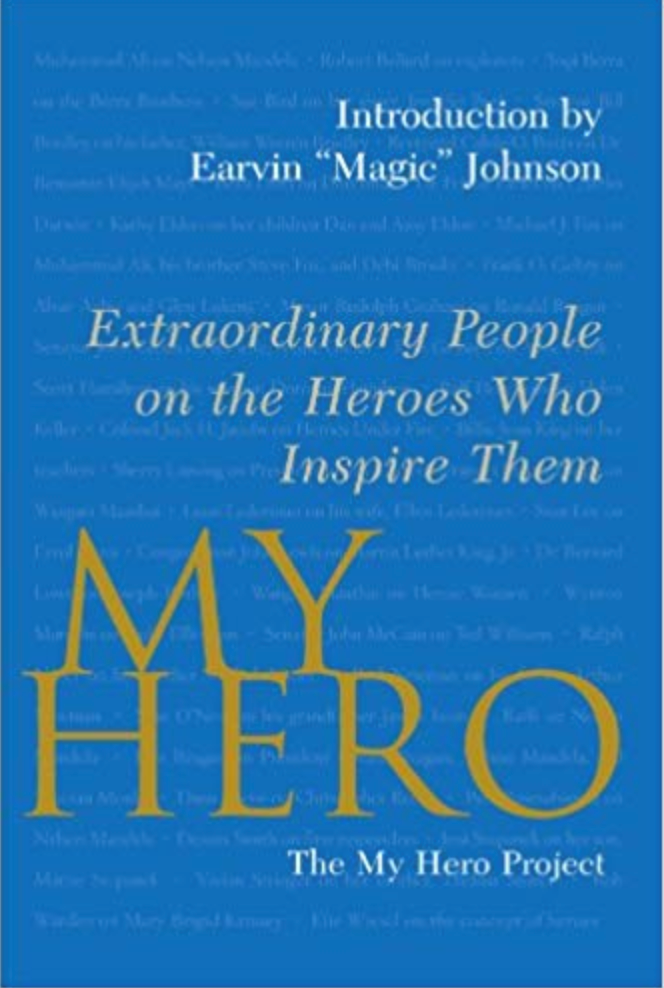
ON THE BOOKS... Frances Moore Lappe is also featured in the book, My Hero as she writes |
RECOMMENDED
READING | |
![]() Diet for a Small Planet by Frances Moore Lappe |
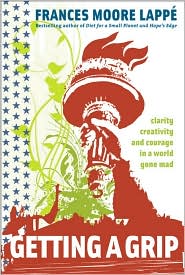
![]() Getting a Grip: Clarity, Creativity and Courage in a World Gone Mad by Frances Moore Lappe |
![]() | ![]() | ![]() | |
| A Sewer Becomes a Water Park with floating botanical gardens that are helping restore ecological health. | Alan Rabinowitz started the first ever jaguar preserve. | Alexandra Cousteau was honored as an Earth Trustee by the UN in 2007 for her work to protect the oceans. | Ansel Adams was an 'artist-activist' whose photographs of nature inspired conservation. |
![]() | ![]() | ||
| Australian Aborigines Protecting Wetlands by working to conserve the environment around them. | Barry Commoner works to protect the environment and raise awareness about the danger of radio activity. | Ben Redclay was an earthkeeper whose legacy lives on through his daughter. | Benjamin Kahn involves school children in regrowing coral to help save damaged reefs in the Red Sea. |
![]() | ![]() | ![]() | |
| Beth Rickard Environmentalist is an advocate of solar as the energy of the future. | Bill Roley taught children in a Mexican orphanage how to work the land. | CAMPUS CENTER FOR APPROPRIATE TECHNOLOGY at Humboldt State University. | Chico Mendes was a father who gave the ultimate sacrifice in defending rainforests. |
![]() | ![]() | ![]() | ![]() |
| Chief Oren Lyons is an internationally venerated advocate for preserving biodiversity. | David Nathan Chain was killed during a nonviolent protest to save the redwoods. | Deland Chan started an environmental group at the YMCA in New York City. | Dennis Weaver is an actor and advocate for ecologically sustainable living. |
![]() | ![]() | ![]() | |
| Dian Fossey worked to protect the endangered Mountain Gorilla. | Donald Knaack is a musician whose unique productions inspire people of all ages to explore, create and give back to others. | Dr. E.O. Wilson studies the impact that human activity has on the planet. | Dr. Elvia Niebla Soil Scientist is dedicated to soil conservation. |
![]() | ![]() | ![]() | |
| Dr. Richard Murphy Marine Biologist educates others about the sea and ways to protect the oceans for the future. | Dr. Robert Ballard and the JASON project bring scientific exploration to children around the world. | Dr. Shirley McGreal founded the International Primate Protection League. | Dr. Vandana Shiva works to preserve biodiversity for the planet. |
![]() | ![]() | ![]() | |
| Envirofit retrofits engines to reduce pollution and enhance energy efficiency in developing countries. | Fin Donnelly works to keep our rivers and waters clean. | Frances Moore Lappe works to eliminate the injustices that cause hunger. | Friends of Nature: Mr. Liang Congjie is a voice for China's environment. |
![]() | ![]() | ![]() | |
| Friends of the Sea Lion rescue, treat, and release these mammals back into the ocean. | George Schaller is a world-renowned naturalist. | Gerald Durrell established the Jersey Wildlife Preservation Trust for endangered species. | Greenpeace works globally to save the environment. |
![]() | ![]() | ||
| Hayrettin Karaca is known as Grandfather Earth for making our planet brighter, greener and better for future generations. | Heather DeWitt is a devoted conservationist. | J.N. (Ding) Darling , conservationist and cartoonist, used his art to raise awareness about the environment. | Jack Johnson is a musician who encourages kids to take care of the environment. |
![]() | ![]() | ![]() | |
| Jack Sim has started a worldwide campaign for clean public toilets and better sanitation standards. | Jacques Cousteau invented the Aqua-Lung, a predecessor to the SCUBA systems used by divers worldwide today. | Jane Goodall is an authority on wild chimpanzees. | Jane Goodall …is a renowned expert on chimpanzees and works to educate people about their own power to improve the environment. |
![]() | ![]() | ![]() | |
| Jean-Michel Cousteau is committed to protecting the ocean for future generations through education and conservation. | Jody Williams is a human rights activist and Nobel Peace Prize winner who began a campaign to rid the world of landmines. | John McConnell founded Earth Day (March 20) and continues his fight for environmental education and awareness. | John Muir advocated preservation, feeling that natural areas promote mental health. |
![]() | ![]() | ![]() | |
| Joseph Ki-Zerbo works to help Africans retain control of their country's agriculture. | Julia Hill brought public attention to deforestation in California. | Kaa-Iya del Gran Chaco National Park is the only park in the Americas established and run by indigenous peoples. | Kory Johnson was honored with the Goldman Environmental Prize in 1998. |
![]() | ![]() | ||
| Laurie David is passionately committed to stopping global warming. | Lee Myung-Bak is responsible for making Seoul, South Korea 'cleaner and greener' during his tenure as mayor. | Marjory Stoneman Douglas worked tirelessly to preserve the Everglades. | Mia Siscawati teaches people to protect their environment. |
![]() | ![]() | ||
| Michael Reynolds Garbage Warrior combines biology and architecture to build sustainable housing. | Mrs. Mei Ng: Friends of the Earth (Hong Kong) uses education to foster environmental awareness in China | My Trip to Catalina Island Slater, a young environmental and peace activist, meets her hero, Jean-Michel Cousteau. | Nicole Dewing and Curtis McCormack joined the Peace Corps and started a waste recycling project in Joal, Senegal. |
![]() | ![]() | ![]() | ![]() |
| Ocean Robbins helps organize young people committed to protecting the planet. | Prigi Arisandi works to educate people on the importance of protecting the rivers of Indonesia | Rachel Carson was the mother of the environmental movement. | Ramani Sankaranarayanan and Geeta Vaidyanathan founded CTxGrEn to show villagers how to turn native materials into fuel for electricity. |
![]() | ![]() | ||
| Reef Ball Foundation restores damaged coral reef systems around the world. | Ric O'Barry works to free captive dolphins around the world. | Robert F. Kennedy Jr. is an eco-warrior defending the earth for future generations. | Robert Redford established the Sundance Film Festival to effect change in the world. |
![]() | ![]() | ![]() | |
| Rory Stear and Kristine Pearson developed and distribute wind-up and solar powered radios to poor communities around the world. | Roxanne Kremer works with the Mestizo Indians of the Peruvian rainforest to save pink dolphins. | Ryan Hreljac helps build wells for clean water in Africa. | Saint Francis of Assisi was a true example of harmonious existence on Earth |
![]() | ![]() | ![]() | |
| Sandra Postel believes in the importance of water conservation. | Severn Cullis-Suzuki an environmental activist, speaker, television host. | Stanislav Petrov averted nuclear disaster, yet remains unknown to most. | SUJANA cleans roads in Indonesia to help the environment. |
![]() | ![]() | ![]() | ![]() |
| Suryo Wardhoyo Prawiroatmodjo educates people in Indonesia to protect the environment. | Sylvia Earle is a marine biologist and ambassador of the oceans. | Terram Foundation brings job growth, community involvement, and local solutions to larger environmental concerns. | Theodore Roosevelt worked tirelessly to protect wildlife and the environment. |
![]() | ![]() | ![]() | |
| Wangari Maathai founded the Green Belt Movement that plants trees to help restore the desolate ecosystem in Africa. | Wes Jackson was a professor who returned to the land to advance sustainable agriculture practices. | William McDonough designs buildings for ecological sustainability. | YouthCaN is a youth- run organization promoting environmental awareness through technology. |
| Zander Srodes and Turtle Talks has educated over 5,000 students on sea turtles and marine conservation. |
Last changed on:10/16/2006 6:49:55 AM
|
|