 |
| Kim Dae-jung |
Kim Dae-jung was born a second son to a farmer living in a small village on the island of Haui off the South Coast of Korea on January 6, 1924. He loved his home village (so much that he was to use its name, Hugwang, as his pseudonym for life). The crashing of the waves, the sea horizon, the water birds, the wind and the warm sunshine there gave him dreams, courage and artistic inspiration. After finishing fourth grade, he moved to Mokpo City on the mainland and attended Bukgyo Elementary School. He graduated from Mokpo Commercial School (currently Jeolla-Jeil High School) in 1943.
Upon graduation, Kim Dae-jung got a job at a shipping company, and by the time Korea was liberated in 1945, he was a successful entrepreneur, well-known among the shipping businesses. He decided to jump into politics when he realized, after experiencing the Korean War and political upheaval, that only righteous politics could save the country. As President Rhee Seung-man became despotic and the pro-Japanese people gained power, Kim vowed to fight against the corrupt regime.
Kim Dae-jung became a christened Catholic in 1957. His baptismal name was Thomas More. His religious faith gave him strength during times of adversity and enabled him to live a life of love and forgiveness.
Politics brought him endless pain and ordeals. He failed in parliamentary elections three times in a row. Then in 1961, he was elected as a member of the Lower House in Inje, Gangwon-do province. But three days after he was elected, the May 16 Military Coup occurred, barring the assembly from being gathered. He could not even be sworn in. All seemed grim, but this was when he met his life-long companion, Madame Lee Hee-ho, who brought a warm ray of sunshine to his life.
In 1963, Kim was elected as a member of the National Assembly in Mokpo. His accomplishments as a lawmaker were outstanding. He was the lawmaker who most frequently went to the National Assembly Library, and he was an active member of many standing committees, ranging from finance, construction, foreign affairs, budget and defense. He eloquently led the way to a democratic society and a unified nation, and once set a record by making the longest remark during a parliamentary session. Gradually, he was engraved in the minds of the Korean people as a statesman with philosophy and purpose, providing vision to all.
Kim barely escaped death four times during his life. He was captured by the communists during the Korean War and escaped from Mokpo prison moments before he was to be shot (1950); he was terrorized in an intentional car accident while campaigning for the 8th general election (1971); he was kidnapped by Korean CIA agents in Tokyo, Japan and rescued moments before being thrown into the sea waters (1973); and lastly, the military court sentenced him to death (1980). The forces against him continuously threatened and coerced him. But Kim Dae-jung did not succumb to, nor compromise with, his opponents. He fought straight on against the military regime.
By choosing the narrow path of democracy, human rights and peaceful reunification, Kim had to endure many years of imprisonment, exile and house arrest. His life was constantly under threat, but in the end, he emerged victorious. He was nominated for the Nobel Peace Prize several times, has been widely respected as one of the main advocates of human rights along with Andrei Sakharov and Lech Walesa, and was nicknamed the "Nelson Mandela of Asia." Kim Dae-jung became the symbol of Korea's democracy, and Korean democracy moved ahead along with Kim Dae-jung.
Though the pains of imprisonment and house arrest were beyond ordinary imagination, he did not waste his time in anger or in despair. During his time of incarceration, he read hundreds of books on various topics, ranging from history, philosophy, economics and literature. This was how he found his peace of mind. One cannot help but be in awe of how deep and broad his reading was upon seeing the list of books that he read. It might have been his reading and meditation that gave him the insights and sense of judgment that helped him go in the right direction whenever he met a crossroad in his life.
Kim Dae-jung himself wrote a number of books. Prison Writings, a collection of letters that he wrote to his family after he was sentenced to death in 1980, was published in many countries around the world. His later publications such as Mass-Participatory Economy, Three-Stage Approach to Peaceful Reunification and For a New Beginning testify to the depth of his intellectual quests.
After two consecutive defeats in the 13th and 14th presidential elections, Kim Dae-jung was finally elected the 15th President of the Republic of Korea in 1997, a feat that marked the first peaceful change of political power in Korea’s history. It was also a victory for the advocates of democracy and the people as a whole.
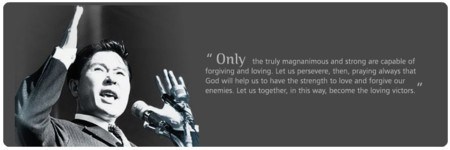
Soon after inauguration, President Kim Dae-jung forgave the dictators and military leaders who had persecuted him so severely in the past. He freed from prison two former Presidents, Chun Doo-hwan and Roh Tae-woo, and demonstrated that forgiveness is the most beautiful virtue, as emphasized in a letter he sent to his son after being sentenced to death at a court martial in November 1980: " ... only the truly magnanimous and strong are capable of forgiving and loving. Let us persevere, then, praying always that God will help us to have the strength to love and forgive our enemies. Let us together, in this way, become the loving victors."
At the time President Kim was elected, Korea was on the verge of bankruptcy, faced with the worst financial crisis ever. Many side-effects of rapid growth were pulling the nation under. President Kim worked with passion. He carried out large-scale reform in the government-led economy. To attract capital, he welcomed all investors and asked for help from all. He implemented sweeping reforms in the financial, corporate, labor and public sectors. Consequently, in August 2001, Korea was able to pay back its loans to the International Monetary Fund three years earlier than planned, and pulled free from the shameful monitoring of the IMF. The world praised Korea as the best example of economic recovery.
During the difficult times of financial crisis, President Kim successfully launched a nationwide broadband network and an IT education initiative for all Koreans, spearheading the nation's bid to become an IT powerhouse. At the same time, he enacted a range of pro-human rights legislation including the Law on Compensations for Democratization Movement, the Law on the Investigation of Suspicious Deaths, and the National Human Rights Committee Law, to ensure that the institution of democracy and human rights protection could firmly take root in the nation. Now, as a result of President Kim's efforts, Korea is recognized as a full-fledged democracy by the global community. In addition, the "Productive Welfare Policy," an implementation of the economic philosophy that had been laid out in President Kim's Mass-Participatory Economy, is regarded as having upgraded Korea’s standards of social welfare one notch.
In June 2000, President Kim led the historic Inter-Korean Summit, the first of its kind since the division of the two Koreas 55 years ago. His "Sunshine Policy" melted the hostility between the South and the North and sprouted a new wave of reconciliation, cooperation and peace on the Korean Peninsula.
In December of that year, Kim Dae-jung was awarded the Nobel Peace Prize, the first time for a Korean, in recognition of his contribution to promoting democratization and human rights in Asian countries such as Korea, Burma and East Timor, and his pursuit of policies to achieve inter-Korean reconciliation and cooperation.
Kim Dae-jung left office in 2003 and went back to the "respectable and beloved" people he could so affectionately relate to. Looking back, it was a long, winding journey, sometimes blocked by high mountains and other times by roaring seas. All the successes and failures along the way will be left to history to evaluate. In the meantime, just like the little boy on Hauido Island, Kim Dae-jung will never stop dreaming about the day when the two Koreas become one and the Earth is full of peace.
Page created on 6/8/2014 9:58:09 AM
Last edited 1/6/2017 10:09:25 PM