 |
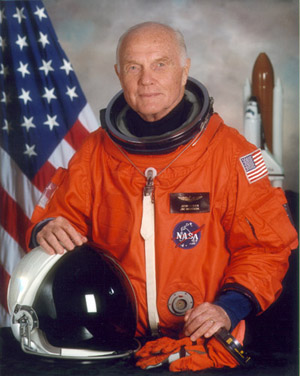
| John Glenn Photo from NASA |
(A) hero...is somebody who is so preeminent in his or her field that it benefits other people and our country. These heroes have dedicated themselves to something that is very important to everybody and their own affairs have become secondary. -John Glenn
At the height of the Cold War between the United States and the Soviet Union, John Glenn launched into space and landed as the first American to orbit the Earth. The year was 1962. The Berlin Wall had just been erected and the prior year saw two Russian cosmonauts successfully orbit the Earth, propelling the Russians to the head of the Space Race. Americans needed a patriotic boost, and NASA's success did just that, with Glenn as the icon of a renewed American pride.
Perhaps John Glenn will always be remembered as the hero in a space suit, but his historic orbit wasn't the first time he served his country well, and it certainly wasn't the last. Long before his fame as an astronaut, John had a strong sense of pride for his country and his duty to serve it, and this attitude and sense of honor and integrity has remained with Glenn throughout his life, from his love of flying, to a decorated military career, and then on to NASA and the US Senate.
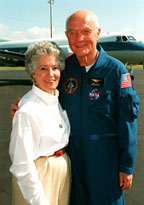 |
| John & Annie Glenn (NASA) |
Growing up in a small town in Ohio during the 1920's and 30's, John learned about the values of hard work, civic duty, and patriotism. John felt a deep sense of community and an individual's responsibility within it. Throughout all of his life there is one person who has remained a continuous source of inspiration and encouragement: his wife, Annie. First a childhood friend, then his high school sweetheart, and now his wife of 60-plus years, Annie has been by his side since they were toddling around in the playpen. From his early childhood, his parents set the example for him, especially his father, an army veteran of World War I and a hardworking plumber in the Glenn family plumbing business. One of his high school teachers inspired him with the belief that even one person could make a difference in improving the lives of other citizens.
Glenn's affinity for flying also began in his hometown, when at age eight, his father took him on his first airplane ride. The short flights in his father's biplane grew to become part of his college curriculum, and his envisioned career path--to be a commercial airline pilot. But after the attack on Pearl Harbor, John left college to enlist in the Naval Aviation Cadet Program. Despite his success in the Navy and his brilliance shown during that first orbit, It wasn't until nearly twenty years later, after his historic spaceflight, that Glenn was awarded a degree in engineering from Muskingum College in New Concord, Ohio.
Glenn piloted fighter planes over the Marshall Islands during WWII and after the war, instructed others in advanced flight training, and even when he had fulfilled his duty to fight in combat, John, after a discussion with Annie, made the decision to fly missions during the Korean War. He has earned six Distinguished Flying Crosses, an award that exists to honor those who display heroism and bravery above and beyond the call of duty. Accomplished and precise, this pilot also proved to be an aviation hero in peaceful times when he set the transcontinental speed record from LA to Long Island. It was the first transcontinental flight to average supersonic speed.
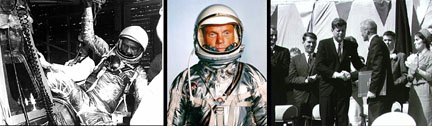 |
| John Glenn during 1962 space mission (left & center); Glenn shaking hands with President Kennedy (right) |
John Glenn's military experience put him on the path to a career in aviation, but his sense of honor, hardworking nature, and quick thinking earned him a spot on NASA's first list of astronauts. All these qualities, in addition to his perseverance and ability to work well under intense pressure, were key components to that first manned orbit on the Friendship 7 and proved to be essential to the integrity of the nation's entire space program. While in orbit, the ship's automatic controls malfunctioned and Glenn ended up taking control of the craft manually, all the while snapping pictures of sunsets, the lights in Australia, and a sandstorm in the Sahara.
After the celebrations of NASA's successful early spaceflights, he continued to work with aeronautics and support the US Space Program unwaveringly, but would remain grounded for thirty-six years. On the 25th anniversary of the Friendship 7, Glenn remarked, "The exploration of the unknown is nothing less than an expression of America's Spirit." Glenn's outer space exploration came full circle in 1998, when he completed one last mission on the Space Shuttle Discovery.
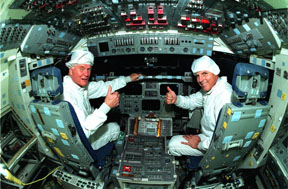 |
| Sen. Glenn in orbiter Columbia, 1998 (NASA Kennedy Space Center) |
In between space missions, John continued in a career serving the public. He ran for the US Senate, and after a few lost races, was elected Senator of Ohio by an overwhelming majority. Senator Glenn fought to clean up decades of environmental waste left by the nuclear weapons surge during the Cold War and helped to create federal legislation to stop the spread of nuclear weapons. In addition to these significant breakthroughs, Glenn also improved the economy and environment of the Great Lakes states and initiated plans to cut fraud within the federal government. Elected for an unprecedented four terms as Ohio senator, he could be counted on for tackling numerous other international and domestic issues with great success and integrity.
After 24 years of service, John retired from the Senate. Yet, there are still times when he wishes he was still working on Capitol Hill, so he continues to find ways to reach out and make a difference in the lives of others. With Annie, he set up the John Glenn Center for Public Service & Public Policy at Ohio State University. The center strives to engage and educate young people in public service, in addition to enhancing the quality of public service and ensuring quality research for public policy.
Public recognition has followed John Glenn throughout his adult life, but despite the fame and his own place in the history of heroes, he sees more heroes in everyday life and people than in public figures. For Glenn, heroes are people who have put their own affairs as secondary and have dedicated themselves to something that is important to the public as a whole. His biggest hero is his wife Annie, who overcame severe stuttering to become an accomplished public speaker and public advocate for people with disabilities. In an interview with MY HERO, Glenn reflects on heroism: "We always think of heroes as being well-known publicly, but I think that we are made up of a whole nation of heroes in their own way. They face problems that are very, very difficult. They face these things with courage...they, too, need recognition."
Each of Glenn's words carries with it a sampling of his passion and integrity, and these qualities and sentiments solidify why John Glenn is a true hero, a hero's hero, and one of the ultimate role models for our times.
Page created on 1/31/2013 12:58:00 AM
Last edited 2/17/2020 9:43:38 PM
MIKE ROWE from WALNUT, CA USA
My hero is: JOHN GLENN. HE WAS THE FIRST MAN TO ORBIT THE EARTH AND THAT TOOK ALOT OF GUTS BECAUSE HE DID NOT KNOW WHAT TO EXPECT UP THERE OR WHAT WOULD HAPPEN ALL THE WAY UP ABOVE THE EARTH. ALL THE TRAINING IN THE WORLD CANNOT TELL YOU WHAT TO EXPECT IN A STRANGE AND NEW WORLD OR ABOVE THE WORLD. THIS IS A GREAT SITE THANKS.
Jon from Kalispell, Montana USA
My hero is: John Glenn. John Glenn is my hero because he was a brave pioneer who risked the dangers of space to expand the frontiers of human experience. And, more recently, he rocketed into space again, reminding Americans of the importance and excitement of space exploration.
Erick Latrell from Duxbury, Vermont
My hero is: John Glenn.
The engines of the mighty rocket flamed up, and a rumble shook the craft. The mighty Mercury 6 shuddered as thrust increased, just on the fringes of shooting the craft into the atmosphere. John Glenn sat in the capsule in the rocket waiting for it to hurl itself into the oblivion of space. The massive rocket lifted off heading for the heavens at tremendous speed. Millions of people stood in awe and in hope that the courageous astronaut would return safely home to earth. The threat of something going wrong was always apparent, but John Glenn was courageous, and daring, and he went forth for his country, for his nation. You would need such determination to do something so daring with the threat of death so closely present. John Glenn, a bright young student from New Concord, Ohio went to a more advanced stage of his life, college. After being enrolled in Muskingum College for four years he was awarded a B.S. in Engineering, the college also awarded him an honorary doctor of science degree in engineering. To become a doctor of anything you need to be extremely smart which is one of the traits I think a hero should possess.
As the rocket Mercury 6 lifted off, anything could have gone wrong. One part of the rocket could be faulty and it could all disintegrate into pieces, but Glenn was determined to get to space, he was anxious. To get to space was for the betterment of the country, but helped to escalate the cold war as well. There were many worries about what could possibly happen to an astronaut. It was a fear that without the right equipment the astronauts' eyeballs would move out of their sockets or change their form. It was also thought that the fluid in the ear would float freely in the air and it would disorient them causing problems with navigation. Determination and courage both intertwine in this case where someone is determined to go to space for mankind and is being courageous, in the face of possible dangers.
John Glenn showed courage and bravery in his career as a pilot in the marine fighter squadron. The planes would zoom by hundreds of miles an hour, by the troop they were to defend while avoiding enemy fire. Glenn flew F4Us in the South Pacific during World War II. He flew 59 missions which for a pilot during World War II is remarkable. Many pilots did not survive that many missions or they never flew that many. By fighting so many missions Glenn was also very daring. He risked his life on every mission, yet came out alive in all of them, that takes guts. In the Korean War he risked his life again as he flew shiny new F-86 Sabrejets. These were fast new planes that were a match for the Russian built MIGs who have been a match for the United States air force for years. In Korea Glenn flew 63 missions for a total of 149 missions in two wars, within a decade. To fight for your country in that many missions and come back alive you have to be (insane), daring, courageous, brave, and pretty determined to survive.