Hugo Grotius, as a hero, seems almost forgotten. Born long ago in the Netherlands, his towering intellect and his earnest yearning for a peaceful world made his writings a beacon of hope to many of the world leaders who came after him. The Founding Fathers of the United States held him in such high esteem that they honored him with a portrait-relief in the Capitol Building. Grotius’ legacy is honored by so many thoughtful leaders of peaceful and prosperous nations that it seems that everyone should know about him.
His life, even though it had a philosophical and intellectual focus, certainly had its moments of excitement and danger. Grotius probably would have had a happy life as a scholar, but he chose instead to put his exceptional intellect to use for the betterment of mankind by writing and speaking out on the vital issues of his day. It was not an easy path to take, but Grotius felt compelled to make a difference in the world and, for this reason alone, he should be considered a true hero.
"A man cannot govern a nation if he cannot govern a city; he cannot govern a city if he cannot govern a family; he cannot govern a family unless he can govern himself; and he cannot govern himself unless his passions are subject to reason."
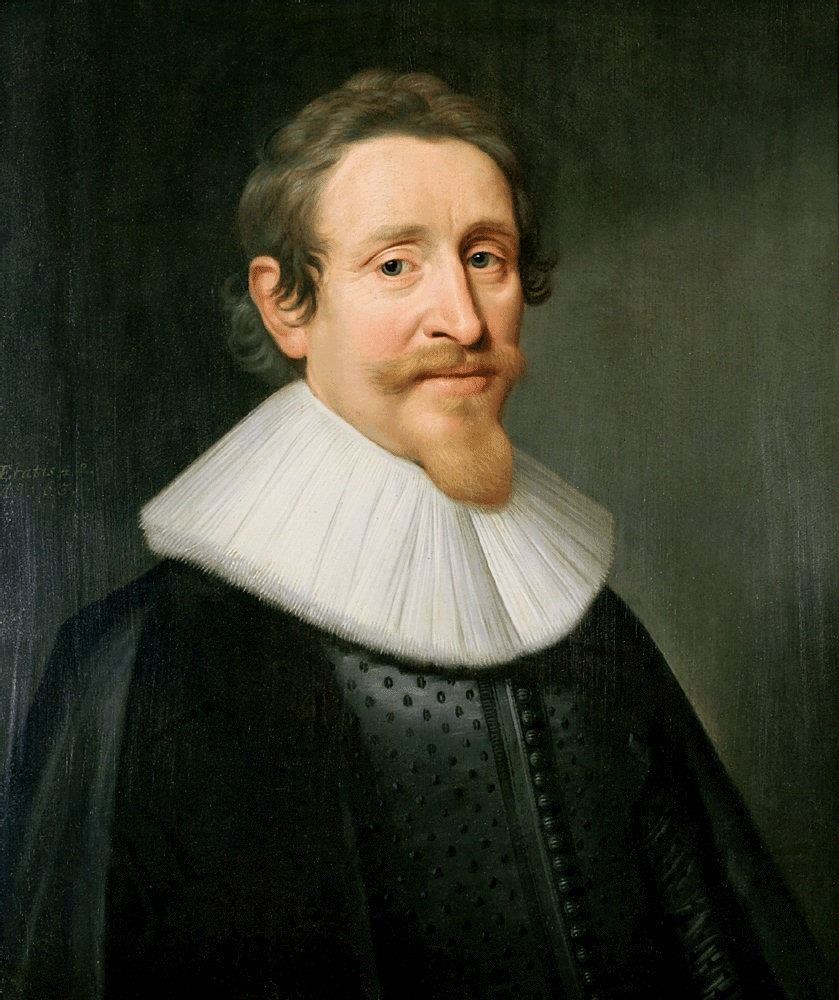 Hugo GrotiusMichiel van Mierevelt / Public domainHugo Grotius [GrO shus], born Huigh de Groot, came into the world on Easter Sunday, April 10, 1583. His birth came within two years of his country's declaration of independence from Spain. The de Groot family had long been valued public servants in the town of Delft in the Netherlands. Hugo’s father, Jan, was mayor of Delft for a time and eventually became curator of Leiden University. The University, established in 1575, was the first in the Netherlands. William of Orange had rewarded the town of Leiden in this way for its heroic part in the Siege of Leiden (which is an important story of its own!).
During his childhood, Hugo was surrounded by notable intellectuals of the day and he was influenced greatly by this environment. In fact, he was known as something of a child prodigy. Although children with outstanding intellectual gifts from wealthy and influential families of this time were not unusual, Hugo stood out even at that.
At the age of eleven, he was enrolled in Leiden University as an adult. Here his prodigious memory helped him learn and explore with ease the subjects of classical languages (Latin and Greek), Arabic and Hebrew, mathematics, physics, Roman law and theology. During this time, he came under the notice of a famed scholar, Scaliger, who encouraged Grotius to begin work on a compendium of knowledge of the fifth century called the “Martianus Capella.” Grotius completed and then published this work, with the scholar’s help, at the age of fourteen. After completing his studies, Grotius was invited to join the Dutch diplomatic mission to France in 1598 where he was introduced to King Henry IV. From the king, he received the honorary title of doctorate from the Université d’Orléans. Henry IV is said to have hailed Grotius as the “Miracle of Holland.”
By the age of sixteen, Grotius had decided on his life’s work. Heeding the advice of his family and mentors, he decided to follow law and to choose a political, rather than a scholarly, profession. He was sworn in as an advocate at The Hague and began a busy legal practice. He found the time to write a history of the origins of the Dutch Republic and even to become the historiographer of Holland. He embarked on a study of comparative constitutions (something that would later have great importance) and on top of all this, was appointed to a position in which he took on the duties of Attorney-General, Public Prosecutor and Sheriff – all by the age of twenty-four! Into this mix, he had also become advocate for the Dutch East India Company and had accepted a commission to write a history of the Dutch war with Spain.
To follow Grotius into this world of the mind would require pages of history, philosophy and the politics of the day. Perhaps the complex world of ideas, as fascinating as it can be, makes the story of someone like Grotius more challenging to tell. However, here is a simple idea that the world takes for granted today: the sea is international territory and all nations should be free to use it for seafaring trade. It’s easy for us to forget that in Grotius’ day, powerful nations claimed large sections of ocean for their exclusive trading rights. It was Grotius who wrote the first definitive essay, Mare Liberum ("free seas," written in 1604 and published in 1608), on why this should be so. Lawmakers in the United States, including the Founding Fathers, took this idea to heart and argued its merits all the way through Woodrow Wilson’s administration. This and so many other writings of Grotius were watershed ideas in the new world of global trade of the early 1600s.
His personal life was enriched when he married nineteen-year-old Maria van Reigersberch in 1608. She was to become an important, even heroic, partner to Grotius. She was from an influential family of burghers, and for the rest of her life she would be Grotius’ strongest supporter.
Since gaining independence from Spain, the Netherlands had been busily developing and strengthening its naval fleet. A truce was reached in 1609, but twelve years later Spain resumed its attacks. In addition to the threat from Catholic Spain, two Protestant religious factions had sprung up within the Netherlands itself. One faction was a strict Calvinist sect, represented by Prince Maurits and other nobles; the other faction was made up of wealthy merchants, whose strong spokesmen included Grotius and Johan van Oldenbarnevelt. This factionalism was further inflamed because of a developing political power struggle between the two groups. Grotius attempted to draw up a peaceful resolution for both sides, but the political issues were deeper than he had realized – now the situation had developed into a struggle between Church and State. His involvement in this attempted resolution (a resolution that would seem reasonable to us today), was to prove personally more dangerous to Grotius than the war with Spain. In 1618 Grotius and van Oldenbarnevelt (his former teacher and mentor) were arrested and tried before an ad hoc Court of Prince Maurits, rather than before the more sympathetic Court of the Province of Holland. Both men were convicted of treason and, in 1619, Van Oldenbarnevelt was beheaded. Grotius, at age 36, was imprisoned for life in Loevestein Castle.
For two years, while in prison, Grotius read numerous books. He also wrote several books of his own. One of these was a book on Old Dutch law, which was written entirely from memory. Introduction to the Jurisprudence of Holland became the foundation on Dutch law, until the Napoleonic Code replaced it in 1809. However, this is not the part of Grotius’ life remembered by many students today. If they have heard the story of Grotius at all, it is because of what happened next – his daring escape! With all of those books going in and out of Loevenstein Castle, Maria thought up a cunning plan. She arranged to have a large book chest taken into Grotius’ cell and helped him to hide inside. Hugo Grotius made his escape and was soon joined by his wife and daughter in France. Here, as refugees, Grotius and Maria waited for ten long years, hoping one day to return to their homeland.
During his exile, Grotius wrote his most important treatise, called The Law of War and Peace, which earned him the title of "The Father of International Law." For this alone, he made his mark in the history books for all time. Never did Grotius lose his faith that man could live by reason and that the world would be a more civilized place if he would set down the laws that would make this possible.
In 1631 he learned that his property in Delft, which had been seized by the government, had been returned to him. Believing this to be a good sign, he decided to test the waters by going back to Holland. However, he did not return quietly. He took up his law practice, got into disputes with some of his old enemies, and ended up having to flee Holland all over again. His hopes that his native country had forgiven him were dashed.
He lived in Germany for two years and then accepted an invitation from the Queen of Sweden to move there. After becoming a Swedish citizen, he was assigned a diplomatic position in Paris, where he became active in helping negotiate a treaty to end the devastating Thirty Years' War. This war had begun in 1618 in Germany, between Catholics and Lutherans, and had spread throughout Europe. By the war's end, in 1648, approximately 15 to 20 percent of Europe's civilians would die. Grotius wrote, "I saw in the whole Christian world a license of fighting at which even barbarous nations might blush. Wars were begun on trifling pretexts or none at all, and carried on without any reference of law, Divine or human."
Grotius would not live to see its end. In 1645, when sailing across the Baltic Sea, he was in a shipwreck off Pomerania. He was taken to Rostock, Germany, where, several days later, on August 28, he died from exhaustion. His body was brought back to Delft for burial. A simple monument, erected in 1781 at the expense of his descendants, resides at The Nieuwe Kerk today.
To many learned scholars, lawmakers, theologians and world leaders, Hugo Grotius was a giant among philosophers/statesmen. His political and historic issues of his day fueled his intellect and imagination, but they may also have caused the deep sense of discouragement he felt by the end of his life as he wrestled with implementing his ideas in the real world. His yearning for peaceful relations between nations, based on natural law and reason, sometimes made him enemies. As though he were expressing these sober views, Grotius' last words before he died were, "By understanding many things, I have accomplished nothing."
He could not know how far his influence would spread, or that he would instill a guiding light in nations yet unborn.
Page created on 6/21/2011 6:39:30 PM
Last edited 4/10/2020 7:37:31 PM
Relief Portraits of Lawgivers honored at the U.S. Capitol Building. Click on "Hugo Grotius" to see his portrait.