 |
| (http://www.poetseers.org/the_poetseers/dante_alighieri/dante) |
If you have never heard of him or studied his work, on first impression some people might think of Dante as a mediocre poet who wrote some unintelligible and very complicated words in Italian or something like that. This essay will definitely change your mind.
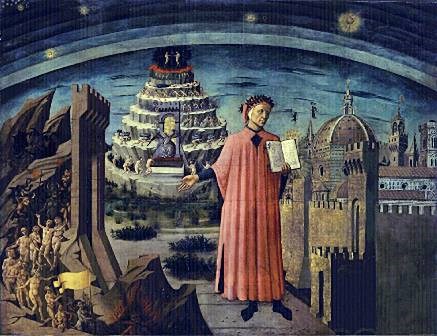
Dante Alighieri was born on May 29, 1265 and died on September 14, 1321. His mother, Donna Bella degli Abati, died when he was 5 or 6, and his father soon remarried Lapa Chiarissimo Cialuffi, who gave birth to two children: Francesco and Tana, Dante's step-siblings. In his childhood Dante was home-schooled and studied many subjects -- Tuscan poetry, painting and music among others. His passion for poetry grew and grew. By the time he was 18, Dante had met many famous artists: Guido Cavalcanti, Lapo Gianni, Cino da Pistoia and others. In 1285, when Dante was about 20, he married Gemma and had three sons with her: Jacopo, Pietro and Antonia. Though he became a father and husband, his young love for a girl named Beatrice, whom he admired from afar as a child, never ceased. He often called her his inspiration to his poems and mentioned her in his Divine Comedy of Hell, Purgatory and Heaven.
At those times in Florence the people were separated into two groups: the rich and educated people, such as scholars and landowners, and the poor beggars and farmers. Though these people were living in the same city and at the same time, they spoke two different languages, which created a very distinct difference between the two classes. The poor spoke the Tuscany dialect while the rich spoke Latin.
Dante was born into a prominent family and was a great poet who came by his career writing in the language of the "rich," but this is not what made him famous. After a long time of writing in Latin, Dante understood something very important, that Florentine culture wasn't only made up of the educated and wealthy, which were only a small part of the population, but also the poor hard laborers. His poems were written for the people, and the people were EVERYBODY, so he started writing his works of art in the Tuscany dialect. After his breakthrough, many other poets began to write in the vulgar language (Tuscany dialect) and because the so-loved poems of the rich were now written in the language of the poor instead of Latin, the Tuscany dialect became the language belonging to EVERYBODY. The Tuscany dialect became what we now know as Italian.
After the death of Beatrice, Dante's life took a sudden turn. He began an intensive philosophical study of the Boethius, Cicero and Aristotle. Though he is mostly known for his poetry, wisdom and knowledge, Dante was also faithful to his Florence and joined the army in 1287 to take part in the Battle of Campaldino. He also became increasingly active in Florentine political affairs and, in 1295, he joined the citizen's government known as the "Council of the Hundred." But after a great debate, he and his council members were stripped of their property and banned from the City of Florence. Like all great artists, Dante felt differently and thought differently; his love and devotion for his city and Beatrice inspired him in his many artworks. He showed that he cared more for others and their good without thinking of the consequences, which brought about his exile. In all ways he was more than just a poet.
Dante Alighieri taught us many things, not only did he enlighten us with his fantastic poetry, but he also gave us a great understanding of the meaning of culture. Culture is EVERYBODY and EVERYBODY should be able to benefit from it! Like he said in the Divine Comedy: "O human race born to fly upward, wherefore at a little wind dost thou fall." In a way he created the Italian language and that is why we call the Tuscan dialect "the true Italian." Dante is a true hero in many ways and follows all the guidelines as he, in a way, fought for the rights of the poor.
Page created on 1/21/2009 12:00:00 AM
Last edited 1/6/2017 7:33:46 PM