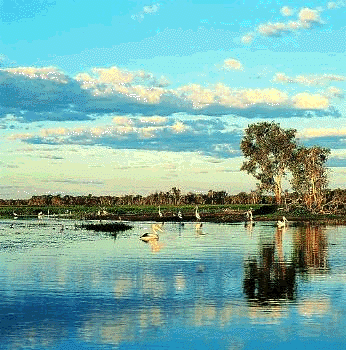
The Wetlands and Native Peoples of Northern Australia Thanks to a variety of climatic zones, Northern Australia is home to a diversity of wetlands, and consequently, a great variety of plants and animals which are a part of these wondrous ecosystems. Likewise, Northern Australia is also home to Aboriginal peoples who have kept their cultural traditions for tens of thousands of years, and who depend on the wetlands for their own survival. Hence, while the wetlands and its creatures rely on mankind for their own survival, in response, the wetlands are providers of life sustenance for the peoples that inhabit these regions. Because the area has largely remained undeveloped and unindustrialized, and because of the presence of native human inhabitants, Northern Australia thrives as a land of wetland conservation, and is a striking example of peaceful coexistence with nature. Harmonious Coexistence
But it is not to say that the wetlands of Northern Australia are not threatened ecosystems. As with most all wetlands, natural factors and human actions pose a threat to their long-term survival. While some humans have threatened these treasures of nature with excessive land development for industry and agriculture, with unfriendly practices, and with uneco-friendly tourism, the Aboriginal peoples of Australia's wetlands have peacefully and fruitfully coexisted with these lands for thousands of years. The nourishing wetlands have created a nurturing relationship with the native Australian peoples, breeding a conservationalist mentality and lifestyle which has survived the test of time, industry, and world economy.
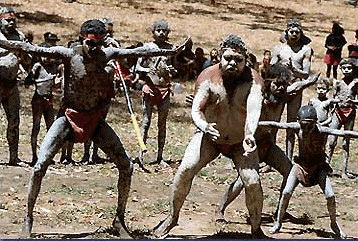
Conservation in Action “The park represents a series of interacting ecosystems that continue to evolve in their natural setting with minimum human disturbance." One such example of harmonious coexistence between the native peoples of a region and the wetlands, themselves, is Kakadu National Park which covers a total area of almost 20,000 square kilometers in Northern Australia, and is a unique archaeological, ethnological, biological, and ecological preserve. The park is owned by Aboriginal peoples, also known as the Kakadu, and managed by an Aboriginal majority representing those traditional owners, along with the Department of Environment and Heritage. Hence, the native peoples of the land have immense input on policy and development, tourism and day-to-day activities, as well as on the long-term environmental well-being of the region.
To the Aboriginal people, Kakadu is more than just a national park, it is vital to their communities
which still occupy the region, their future as a people, and their historical preservation. Also famous for its cave paintings and rock carvings, the park serves as a record of the area's inhabitants, from the hunter-gatherers of prehistoric times to the Aboriginal people who still inhabit the land, and of their long-term interaction with the environment. Hence, their love for a region which has sustained them for at least 25,000 and possibly 40,000-60,000 years also ensures that they will protect it.
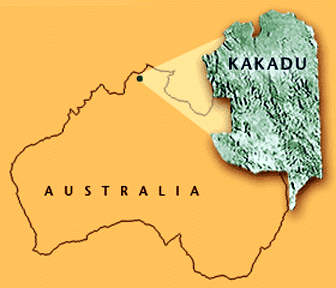
In Kakadu, during the wet season, rivers flood and spread out over the flood plains, forming extensive wetlands, where fowl abound. These wetlands are considered 'Wetlands of International Importance Especially as Waterfowl Habitat' by the Ramsar Convention. Home to more than 10,000 species of insects, Kakadu, as with other wetlands, has often been naively mistaken by those unfamiliar with the benefits of flood plain and swamp-type wetlands, as ‘mosquito breeding grounds.’ But the park is also home to more than 60 species of mammals, 289 bird species, 132 reptile species, 25 frog species, and 55 species of freshwater fish, and a plethora of plant life. Hence, these creatures also depend on the Aboriginal peoples and their work to environmentally sustain the region.
Kakadu has thrived because of the input of the native peoples, their knowledge of the land and its needs, its natural patterns, seasonal and historical changes, animal and plant life, and the like, creating a unique relationship in which those who understand the land best, can offer modern-day scientists, researchers, and developers, constant input on the land’s current and future use and sustainability.
|
|
|
|
Did you know?
Throughout history, the Northern Australian wetlands have offered (amongst other things) the Aboriginal peoples of the area: |
![]() | ![]() | ![]() | |
| A Sewer Becomes a Water Park with floating botanical gardens that are helping restore ecological health. | Alan Rabinowitz started the first ever jaguar preserve. | Alexandra Cousteau was honored as an Earth Trustee by the UN in 2007 for her work to protect the oceans. | Ansel Adams was an 'artist-activist' whose photographs of nature inspired conservation. |
![]() | ![]() | ||
| Australian Aborigines Protecting Wetlands by working to conserve the environment around them. | Barry Commoner works to protect the environment and raise awareness about the danger of radio activity. | Ben Redclay was an earthkeeper whose legacy lives on through his daughter. | Benjamin Kahn involves school children in regrowing coral to help save damaged reefs in the Red Sea. |
![]() | ![]() | ![]() | |
| Beth Rickard Environmentalist is an advocate of solar as the energy of the future. | Bill Roley taught children in a Mexican orphanage how to work the land. | CAMPUS CENTER FOR APPROPRIATE TECHNOLOGY at Humboldt State University. | Chico Mendes was a father who gave the ultimate sacrifice in defending rainforests. |
![]() | ![]() | ![]() | ![]() |
| Chief Oren Lyons is an internationally venerated advocate for preserving biodiversity. | David Nathan Chain was killed during a nonviolent protest to save the redwoods. | Deland Chan started an environmental group at the YMCA in New York City. | Dennis Weaver is an actor and advocate for ecologically sustainable living. |
![]() | ![]() | ![]() | |
| Dian Fossey worked to protect the endangered Mountain Gorilla. | Donald Knaack is a musician whose unique productions inspire people of all ages to explore, create and give back to others. | Dr. E.O. Wilson studies the impact that human activity has on the planet. | Dr. Elvia Niebla Soil Scientist is dedicated to soil conservation. |
![]() | ![]() | ![]() | |
| Dr. Richard Murphy Marine Biologist educates others about the sea and ways to protect the oceans for the future. | Dr. Robert Ballard and the JASON project bring scientific exploration to children around the world. | Dr. Shirley McGreal founded the International Primate Protection League. | Dr. Vandana Shiva works to preserve biodiversity for the planet. |
![]() | ![]() | ![]() | |
| Envirofit retrofits engines to reduce pollution and enhance energy efficiency in developing countries. | Fin Donnelly works to keep our rivers and waters clean. | Frances Moore Lappe works to eliminate the injustices that cause hunger. | Friends of Nature: Mr. Liang Congjie is a voice for China's environment. |
![]() | ![]() | ![]() | |
| Friends of the Sea Lion rescue, treat, and release these mammals back into the ocean. | George Schaller is a world-renowned naturalist. | Gerald Durrell established the Jersey Wildlife Preservation Trust for endangered species. | Greenpeace works globally to save the environment. |
![]() | ![]() | ||
| Hayrettin Karaca is known as Grandfather Earth for making our planet brighter, greener and better for future generations. | Heather DeWitt is a devoted conservationist. | J.N. (Ding) Darling , conservationist and cartoonist, used his art to raise awareness about the environment. | Jack Johnson is a musician who encourages kids to take care of the environment. |
![]() | ![]() | ![]() | |
| Jack Sim has started a worldwide campaign for clean public toilets and better sanitation standards. | Jacques Cousteau invented the Aqua-Lung, a predecessor to the SCUBA systems used by divers worldwide today. | Jane Goodall is an authority on wild chimpanzees. | Jane Goodall …is a renowned expert on chimpanzees and works to educate people about their own power to improve the environment. |
![]() | ![]() | ![]() | |
| Jean-Michel Cousteau is committed to protecting the ocean for future generations through education and conservation. | Jody Williams is a human rights activist and Nobel Peace Prize winner who began a campaign to rid the world of landmines. | John McConnell founded Earth Day (March 20) and continues his fight for environmental education and awareness. | John Muir advocated preservation, feeling that natural areas promote mental health. |
![]() | ![]() | ![]() | |
| Joseph Ki-Zerbo works to help Africans retain control of their country's agriculture. | Julia Hill brought public attention to deforestation in California. | Kaa-Iya del Gran Chaco National Park is the only park in the Americas established and run by indigenous peoples. | Kory Johnson was honored with the Goldman Environmental Prize in 1998. |
![]() | ![]() | ||
| Laurie David is passionately committed to stopping global warming. | Lee Myung-Bak is responsible for making Seoul, South Korea 'cleaner and greener' during his tenure as mayor. | Marjory Stoneman Douglas worked tirelessly to preserve the Everglades. | Mia Siscawati teaches people to protect their environment. |
![]() | ![]() | ||
| Michael Reynolds Garbage Warrior combines biology and architecture to build sustainable housing. | Mrs. Mei Ng: Friends of the Earth (Hong Kong) uses education to foster environmental awareness in China | My Trip to Catalina Island Slater, a young environmental and peace activist, meets her hero, Jean-Michel Cousteau. | Nicole Dewing and Curtis McCormack joined the Peace Corps and started a waste recycling project in Joal, Senegal. |
![]() | ![]() | ![]() | ![]() |
| Ocean Robbins helps organize young people committed to protecting the planet. | Prigi Arisandi works to educate people on the importance of protecting the rivers of Indonesia | Rachel Carson was the mother of the environmental movement. | Ramani Sankaranarayanan and Geeta Vaidyanathan founded CTxGrEn to show villagers how to turn native materials into fuel for electricity. |
![]() | ![]() | ||
| Reef Ball Foundation restores damaged coral reef systems around the world. | Ric O'Barry works to free captive dolphins around the world. | Robert F. Kennedy Jr. is an eco-warrior defending the earth for future generations. | Robert Redford established the Sundance Film Festival to effect change in the world. |
![]() | ![]() | ![]() | |
| Rory Stear and Kristine Pearson developed and distribute wind-up and solar powered radios to poor communities around the world. | Roxanne Kremer works with the Mestizo Indians of the Peruvian rainforest to save pink dolphins. | Ryan Hreljac helps build wells for clean water in Africa. | Saint Francis of Assisi was a true example of harmonious existence on Earth |
![]() | ![]() | ![]() | |
| Sandra Postel believes in the importance of water conservation. | Severn Cullis-Suzuki an environmental activist, speaker, television host. | Stanislav Petrov averted nuclear disaster, yet remains unknown to most. | SUJANA cleans roads in Indonesia to help the environment. |
![]() | ![]() | ![]() | ![]() |
| Suryo Wardhoyo Prawiroatmodjo educates people in Indonesia to protect the environment. | Sylvia Earle is a marine biologist and ambassador of the oceans. | Terram Foundation brings job growth, community involvement, and local solutions to larger environmental concerns. | Theodore Roosevelt worked tirelessly to protect wildlife and the environment. |
![]() | ![]() | ![]() | |
| Wangari Maathai founded the Green Belt Movement that plants trees to help restore the desolate ecosystem in Africa. | Wes Jackson was a professor who returned to the land to advance sustainable agriculture practices. | William McDonough designs buildings for ecological sustainability. | YouthCaN is a youth- run organization promoting environmental awareness through technology. |
| Zander Srodes and Turtle Talks has educated over 5,000 students on sea turtles and marine conservation. |
Last changed on:3/18/2005 12:40:43 PM
|
|