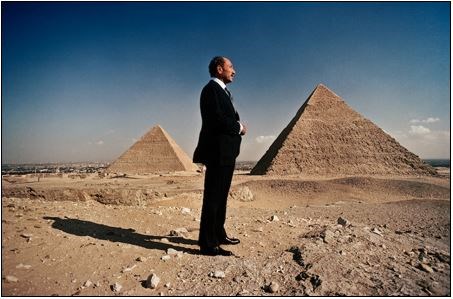
| "Peace is much more precious than a piece of land... let there be no more wars." ~ Mohamed Anwar El Sadat |
Bravery, honesty, loyalty, and others, all these were characteristics of former Egyptian president, Mohamed Anwar El Sadat. He was born on 25 December 1918 into a family of 13 children. His father was a government clerk and his mother Sudanese. He was named after Ismail Anwar, also known as Anwar Pasha, the Turkish war minister who was a Middle East war hero who held the city of Edirne during the Balkan wars in 1918, the year of Sadat’s birth.
Sadat had a happy childhood. He grew up among average Egyptian villagers in the town of Mit Abul Kom, Menufeya, which is 40 miles to the north of Cairo. Egypt was by that time a British colony. From an early time in his life, Anwar al-Sadat developed anti-colonial beliefs. Sadat was a devout Muslim from his early days, benefiting from an Islamic education. Later he joined the military school in Egypt. After his graduation, he was posted to a remote government base, where he met Gamal Abdel-Nasser. This was supposed to be the turning point of his life.
During the Second World War, Anwar El Sadat was imprisoned by the British because of the provocative help he offered to the Germans to expel the British from Egypt. However, he escaped two years later. In 1946 Sadat was rearrested, because of his entanglement in the assassination of a pro-British minister. He was released two years later. In prison, Sadat wrote a book called, In Search of Identity. Later after his release, he joined the "free officers' organization" which led a coup against the royal government of King Farouk in 1952, and he supported Nasser's election as Egyptian president in 1956. Upon Nasser's death in 1970, Anwar al-Sadat was elected president of Egypt.
One of his most important domestic accomplishments was the so-called "open-door policy": an approach that included decentralization of the economy, as well as opening Egypt to foreign trade and investment, which had a negative impact, including higher inflation and the uneven distribution of wealth. In foreign policy, Sadat made enormous efforts. Upon his ignored request to get more military support from the Soviets, he expelled advisers from Egypt. In 1973, he led Egypt through the 6th of October war, also known as the Yom Kippur War, to get back Sinai, which had been occupied by the Israelis since 1967. The Egyptian army managed to cross the Suez Canal, accomplishing a significant victory. For many years after, Sadat was known as the ‘Hero of the Crossing’. This war paved the way to further peace negotiations with Israel. "Peace is much more precious than a piece of land... let there be no more wars," was one of Sadat's quotes. This quote really shows how much he was interested in the Egyptian government. Three wars against Israel left Egypt struggling economically.
In 1978 Sadat made his most important diplomatic act: He visited Israel and addressed a speech to the Knesset. On March 26th, 1979, he signed the Peace Treaty with Prime Minister Menachem Begin in Washington, DC, United States. He also won a Nobel Prize for Peace. He wanted to initiate peace negotiations between Israel and Palestine, but unfortunately he never got the chance.
As a last act of heroism, he accepted hosting the ousted Shah of Iran when every other country on earth refused to. When the Shah died after a complication in a simple abdominal surgery, al-Sadat gave him an official funeral suitable for a leader of a big nation, risking his own life with the Islamic fundamentalists.
In Egypt, the controversial peace agreement with Israel generated opposition, especially among Muslim fundamentalist groups. On the 6th of October, 1981, during a parade celebrating the 1973 victory, Sadat was assassinated. He was succeeded by President Hosny Mobarak. Anwar El-Sadat deserves to be called a hero for many reasons: He was the one who returned the Sinai Peninsula to Egypt in October 1973 after years of Israeli occupation. He also was the first Egyptian leader to take the bold action of visiting Israel, and thus created peace between Egypt and Israel after three exhausting wars, for which he received a Nobel Prize for Peace. Furthermore, he introduced Egypt to the "open-door policy", which allowed people from every social status to participate in the economy and trade. Anwar El-Sadat was a man of vision and strong will. He moved in life between extreme poverty, army positions, small private jobs and a statesman position. He spent time in prison, gaining a deeper understanding of himself. His understanding of world politics was quite ahead of his time for the region. In his race to accomplish his ambition, he risked his own life and finally lost it in 1981. I think, if he had survived a bit longer, he would have changed the political map of the Middle East.
|
|
Written by
Youssef from Cairo
|
|
Mohamed Anwar El Sadat ibiblio.org The Nobel Peace Prize 1978 Egyptian President Mohamed Anwar al-Sadat and Israeli Prime Minister Menachem Begin share the Nobel Peace Prize in 1978. El Sadat: Man of War and Peace This website highlights the achievements and contains most of the speeches and statements of the late Egyptian President Anwar Sadat. |
![]() | ![]() | ![]() | ![]() |
| Amy Biehl gave her life to ending apartheid in South Africa. | Andrei Sakharov was a Russian Nobel Peace Prize winner devoted to justice and human rights. | Andrew Greene Jr. of Sierra Leone teaches the world about peace. | Archbishop Oscar Romero was a passionate voice of hope, peace and justice in war-torn El Salvador. |
![]() | ![]() | ![]() | |
| Ashoka was a fierce warrior-king who changed his ways and became a beloved peacemaker. | Atsuko Shiwaku set up the International Intercultural Mural Exchange Project to promote peaceful coexistence. | BETTY BIGOMBE was named 'Uganda’s Woman of the Year' in 1994 for her efforts to negotiate peace in Uganda. | Chief Arvol Looking Horse appeals to indigenous voices across the world to bring peace. |
![]() | ![]() | ![]() | ![]() |
| Coalition of Women for Peace aims to make women a key part of the peace process in the Middle East. | Corbin Harney has spread a message of peace throughout the world. | Craig Kielburger believes kids can change the world. | Dr. Caldicott has been a lifelong anti-nuclear activist. |
![]() | ![]() | ![]() | ![]() |
| Dr. Ed Gragert works towards peace and global education. | Dr. Fareed Zakaria offers the world a rare perspective on East-West relations. | Elie Wiesel wrote the famous Holocaust memoir Night. | Elie Wiesel is a Holocaust survivor and author, whose work spreads a message of peace. |
![]() | ![]() | ![]() | ![]() |
| Emily Greene Balch received the Nobel Peace Prize in 1946. | Florence Kelley was a faithful fighter for child labor laws, women's rights, and civil rights in the U.S. | Friends Without Borders is building peace through children's heartfelt letters to one another in India and Pakistan. | Gerson Andres Florez Perez was nominated for the Nobel Peace Prize at age 16. |
![]() | ![]() | ![]() | |
| Greg Mortenson promotes peace by building schools in Pakistan and Afghanistan. | Guernica : Picasso's work of art evokes peace worldwide. | Hadraawi, Beloved Peacemaker / Poet of Somalia is a powerful voice for peace in his country. | Hassan 2 was a monarch who worked for peace in the Middle East |
![]() | ![]() | ![]() | ![]() |
| Hugo Grotius was a scholar who advocated for peace between nations based on natural law and reason. | Ibrahim Alex Bangura makes music that sends a message of peace and tolerance. | Jason Crowe received the UN's Global Peace & Tolerance Award. | Jehan Sadat is a leader for peace and women's rights in Egypt. |
![]() | ![]() | ![]() | |
| Jimmy Carter has dedicated his life to humanitarian and philanthropic causes. | Jimmy Carter For as long as she can remember, Sherry Lansing has considered President Carter her hero. | John Wallach helps young people learn to make friends of enemies. | Kim Dae-Jung brought democracy and economic stability to South Korea. |
![]() | ![]() | ||
| Kimmie Weeks survived the war in Liberia and now works to rebuild communities in war-torn countries. | Kofi Annan is an honored freedom and peacemaker hero. | Le Ly Hayslip is a humanitarian, memoirist, and powerful peacemaker. | Loung Ung from Cambodia is a national spokesperson for a landmine-free world. |
![]() | ![]() | ||
| Lyndon Harris: People Making a Difference founded The Gardens of Forgiveness Project. | Malika Sanders was born into the Civil Rights Movement and continues work today. | Marc Kielburger is a human rights activist who has dedicated his life to helping others. | Martin Luther King, Jr. brought change through non-violence. |
![]() | ![]() | ![]() | ![]() |
| Martin Luther King, Jr. was a hero of faith, peace, and tolerance. | Mattie Stepanek is a hero to people of all ages around the world. | Mattie Stepanek: For Our World Mattie’s poems of peace and hope have touched millions of lives | Mohamed Anwar al-Sadat came to be a great advocate for peace. |
![]() | ![]() | ![]() | ![]() |
| Mohamed Anwar El Sadat risked his life for peace. | Mohamed ElBaradei is dedicated to ridding the world of nuclear weapons. | Mohandas K. Gandhi used non-violence to free India from British rule. | Muhammad Yunus started a bank for poor people in Bangladesh. |
![]() | ![]() | ![]() | |
| My Hero & Childnet ask "How can we use the Internet as a Tool for Peace and Hope?" | Nickole Evans is using technology for peace. | Oprah was honored by the Elie Wiesel Foundation for Humanity . | Oscar Arias Sanchez won a Nobel Peace Prize for his efforts to establish peace in Central America. |
![]() | ![]() | ||
| Peace Children voted overwhelmingly for peace and change. | Peace Palace International Court Of Justice seeks global peace and justice by settling disputes between countries. | Peace Pilgrim walked over 25,000 miles for peace. | PeaceJam Foundation Students from around the world focus on a Global Call to Action for peace on the anniversary of 9/11. |
![]() | ![]() | ![]() | ![]() |
| Postpessimists is working for change in the Balkans. | Rigoberta Menchu Tum was the first Guatemalan to receive the Nobel Peace Prize. | Romeo Alain Dallaire is a celebrated humanitarian for his work during the Rwandan genocide. | Ron Kovic has worked for peace for over three decades. |
![]() | ![]() | ||
| Roshi Bernie Glassman finds peace in using Zen to help others. | Ruty Hotzen inspires students from around the world through Talking Kites, iEARN. | Ryuichi Hirokawa photographer who illuminates the needs of children in crisis. | Sarah Winnemucca was an advocate for Paiute rights and the first Native American woman to publish a book. |
![]() | ![]() | ![]() | |
| The Art Miles Mural Project teaches respect and understanding through art. | The Everest Peace Project promotes peace, teamwork, and cultural understanding. | Theodore Roosevelt won the Nobel Prize for Peace for brokering a treaty between Japan and Russia. | UWC Initiative for Peace brings together teens from India and Pakistan to discuss nuclear disarmament. |
![]() | ![]() | ||
| Winston Churchill was one of the first to recognize and warn others of Hitler's danger to freedom and human rights. | Yitzhak Rabin made peace a priority as the leader of Israel. |
Last changed on:7/27/2009
|
|