 |
Can dolphins cure depression and other disorders in humans? Are they able to relieve symptoms of human behavioral and nervous disorders? Some scientists believe these highly intelligent creatures can be trained to do remarkable things.
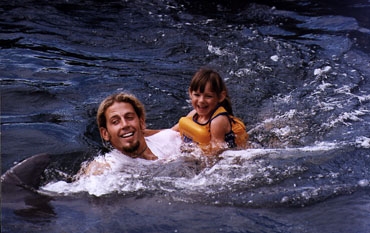 |
One woman who has seen the potential for dolphins to aid in healing humans is Russian scientist, Dr. Ludmila Lukina. She retrained Dolphins who had formerly been used in Russia to explode war machinery and gave them a new objective as part of a revolutionary 1986 study on "Dolphin Assisted Therapy."
Lukina’s research team at the State Oceanarium of Ukraine, (located in the Sevastopol, Crimea), conducted a study which resulted in dramatic results. The team was able to build a methodology, a theoretical base, and practical recommendations for a kind of dolphin therapy used by adults and children suffering from a range of diseases, including autism.
Many of her more than 1,000 subjects were recommended dolphin therapy by their regular doctors because traditional therapy did not work for them. Those who participated in Lukina's 1986 study showed elevated moods and an increase in their productivity. In particular, interaction with dolphins showed significant effects in the treatment of patients with cerebral paralysis, stammering, and specialized phobias.
The inspirational elements of the Dolphin Assisted Therapy employed by Lukina and other dolphin specialists are based on theories that have been useful in several other types of rehabilitative therapies. The key elements are reward and motivation. The subject is asked to perform certain tasks that challenge him or her in areas such as speech and language or motor skills. Mastery of those tasks results in the reward of participation in a behavior with the dolphins.
Other kinds of dolphin therapy include the use of dolphin communications. Dr. Horace Dobbs, working in the United Kingdom, has made impressive strides with dolphin therapy for people suffering from conditions such as anorexia nervosa.
Dobbs reasoned that since music is known to alter moods and affect our well-being, dolphins' sonic communications could play a part in alleviating depression. He took the concept one step further by distributing thousands of copies of an audio cassette called Dolphin Dreamtime, which takes listeners on a mental journey into the dolphin's realm- to swim with them.
In the 21st Century, scientists will continue to study the applications for dolphin assisted therapy, while grappling with the moral implications of taking animals away from their natural environment. Should dolphins be removed from their place in the sea in order to help with scientific discovery? Should animals ever be used to help countries during wartime?
What do you think? Write about it in our guestbook.
Page created on 7/27/2014 12:49:10 PM
Last edited 8/21/2018 4:28:17 PM
This article was based on a story by Michael Specter published in The New York Times
Selected Bibliography on
Dolphin Assisted Therapy
Cochrane, A & Callen, K. (1992). Dolphins and Their Power to Heal - Healing Arts Press, One Park Street, Rochester, Vermont 005767, USA.
De Bergerac, O. (1998). The Dolphin Within - Sydney: Simon & Schuster.
Dobbs, H. (1990). Dance to a Dolphin's Song - London: Jonathan Cape.

Jeanne from Laguna wrote about the moral question of military training for dolphins.
The success of scientist Ludmila Lukina's program, which retrained dolphins to have peaceful objectives, shows the ability of animals to adapt to peace, and hopefully man will be able to do so as well. This program is a wonderful demonstration of the potential for governments to rethink the use of military operations for peacetime programs.