 |
Jesus was a teacher and prophet who lived about two thousand years ago. Over one third of the world's population call themselves Christians, or those who follow the teachings of Jesus. There are about 10 million Christians in China alone. Christians believe that Jesus Christ is the Son of God and the Messiah, or the Savior promised by the Bible. "The Christ" literally means "the anointed one," another word for the Messiah.
The importance of Jesus is evident is many ways. The common calendar uses his birth as a starting point, with "2002 A.D.", or Anno Domini, being Latin for "in the year of our lord." Dates reckoned before Christ's birth are "B.C.," or "before Christ." Sunday, the day of Christ's resurrection, is still regarded as a day of rest. Other Christian holidays are also celebrated by millions, especially Christmas and Easter, the days when Jesus' birth and resurrection are remembered. Thousands of Christian churches can be found throughout the western world. The Bible, in which the story of Christ's life can be found, is one of the best-selling books of all time, and has been translated into over 2,000 languages.
The story of Jesus' life is told in the New Testament of the Bible. His mother Mary was a poor Jewish woman. Her husband Joseph was a carpenter. Mary was still a virgin when she conceived Jesus. The holy spirit came to the Virgin Mary and the "King of Israel" was born in a manger in Bethlehem. This is a small village near Jerusalem in Israel. Joseph and Mary took Jesus to Egypt to escape from King Herod, who had heard prophecies about Jesus and was jealous of anyone who might take away his power. The three wise men, learned sages from the Middle East, also knew the prophecies and came to give gifts to the baby Jesus in Egypt. Jesus spent most of his years in Nazareth, a city in Israel, where he learned his father Joseph's trade of carpentry. Jesus waited until the age of 30 before starting his ministry of prophecy, miracles, and teaching.
Most of the four Gospels in the Bible focus on this phase of Jesus' life. Gospel means "good news," and these four books were written by Matthew, Mark, Luke, and John, four of the earliest followers of Jesus. After gathering a group of twelve disciples, Jesus spent the next three years traveling in Israel, teaching and doing miracles, including healing and raising of the dead. His teachings emphasized loving God and following God's laws rather than adhering to the rules imposed by human society. Jesus also prophesied that he was the Son of God and the ultimate path of salvation. "I am the way, the truth, and the life," said Jesus; "no one comes to the Father except through me." Because he appeared to be the savior and because of his care for the common people, Jesus attracted a large following.
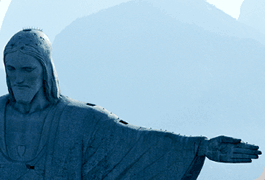 |
| The Statue of Jesus at Corcovado, Rio de Janeiro |
After three years of this ministry throughout Israel, Jesus had begun to make enemies among the established religious leaders in Jerusalem. Especially opposed to Jesus' work were the groups known as the scribes and Pharisees, who objected to Jesus' challenges to their highly ritualistic traditions. After recruiting Judas, one of Jesus' own disciples, to betray him, the enemies of Jesus had him arrested by the local Roman authorities. After a trial, Jesus was condemned to death on a cross. This was also known as crucifixion, a painful form of capital punishment practiced by the Romans, in which the victim was nailed to a wooden cross and hung there until dead. The signs that accompanied Jesus' death made many more believers, especially when Jesus' body disappeared after having been buried for three days, and it was reported that Jesus had risen from the dead. Soon afterwards, Jesus appeared to his former disciples and many others, and he was seen ascending into heaven.
Christians believe that Jesus lived a blameless life while on earth, and that his death was thereby a suffering on their behalf of the ultimate consequences of their own wrongdoing. Jesus' resurrection, the most important belief of Christians, is a symbol that human wrongs have been overcome once and for all, and that salvation is now available for everyone who believes. Christians celebrate these truths in the sacraments, or holy rituals of remembrance. The most important sacraments are baptism and communion. Baptism, or being submerged in water, is a sign that the Christian has followed Christ into the grave (the water) and has now entered into a new life. Communion, in which Christians eat bread and wine, symbolizes the sacrifice of the body and blood of Christ.
After Christ's ascension to heaven, the Holy Spirit, the Spirit of God, came down and filled Jesus' disciples. The disciples now became known as apostles, and spent the rest of their lives doing miracles and spreading the teachings of Jesus to many countries. Wherever they went, the apostles taught the sacraments and formed groups of believers, or fellowships. These fellowships eventually became the different churches, or denominations, that most Christians identify with today. The largest Christian groups are Orthodox, Catholic, and Protestant, which includes such denominations as Anglican, Episcopal, Methodist, Lutheran, Presbyterian, Baptist, and Unitarian, as well as many others. But although Christians belong to many different churches, live in many different countries, and speak many different languages, they are united in their common belief in the life and teachings of Jesus Christ.
Page created on 12/7/2003 9:35:44 PM
Last edited 1/9/2017 4:33:57 PM

Jesus said, “The wind blows where it wills and you hear the sound of it, but you do not know whence it comes or whither it goes. So it is with everyone born of the spirit.”
Whatever else this passage may say, what it says to me is that change is possible -- change is always possible. It says that no matter what your genes may be, no matter what kind of personal hell you were brought up in, no matter what life may have been like for you as a child, no matter what oppressive political regime you may be a victim of, the human spirit is such that radical change is possible.
Jesus himself was an illustration of this principle. He was an example of the unpredictability of the human spirit. Sarcastically, the Pharisees, speaking of Jesus, said, “Study the scriptures and you will find the prophets do not come from Galilee.” Operating under their own brand of theological determinism, the Pharisees believed that nothing good could come from Nazareth. Frankly, to them, Nazareth was on the wrong side of the tracks. Surely a prophet would have gone to the best schools that money could buy. There were no prestigious schools in Nazareth. Besides, it was written in the scriptures where a Messiah would come from; it was right down there in black and white, and Jesus didn’t have the right credentials. His heritage, His environment, His nuturing attitude, His nature, His genetics were all wrong for a messiah. But I, for one, am glad Jesus was born on the wrong side of the tracks.
I’m glad His birthplace was a manger and not a castle. I’m glad that He conquered Jerusalem on a donkey and not on a stealth bomber. I’m glad His mother and father had a rough beginning of it. I’m glad that He was trained as a carpenter and not as a high-priced theologian. I’m glad His life was a contradiction to the written word and the expectations of the people of Israel. I’m glad His life was an example of freedom, an example that with the heroic spirit that lives in each and everyone of us absolutely anything is possible. No matter what your genes and no matter what your environment, Jesus’ life is a statement of the impossible possibilities that are true for all of us.