 |
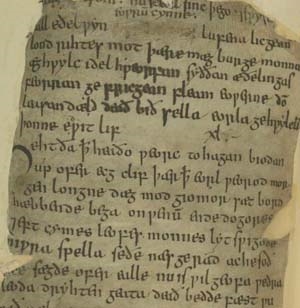
"Beowulf" is the oldest surviving English epic poem, written sometime in the 7th or 8th century. It is about the great Scandinavian hero Beowulf's journey to free Denmark by slaying the ogre, Grendel. Beowulf is made king of Geatland, his homeland, but is eventually killed by a fire-breathing dragon. The only known manuscript is in the British Museum in London. It is written in Old English, but translations can be found on the Internet. The name of the poet who wrote Beowulf is unknown.
Matt Killenbeck writes:
After reading the story of "Beowulf," I think Beowulf is my hero. The story described a perfect hero. He was strong, an outstanding fighter and very loyal to all who came into his presence. The story gives examples of his great courage and his fierce strength. In the story, Beowulf took on sea monsters and crushed them in his grip. When Beowulf went into battle, he believed in a fair fight. He believed that no fighter should have the upper hand.With his skills and talent, he can overcome all. He fears no enemy. When fighting Grendel, a monster who has been terrorizing a village in the story, Beowulf fights hand-to-hand. This feat took great courage and skillful fighting. Beowulf fought many great battles. In his last battle, Beowulf was fatally wounded, but he won the battle before he died. This was the fall of a great hero.
Last, Beowulf was a very loyal hero. He showed fairness to all he came across, including his enemies. He believed that everybody was equal and no one was greater or better than anybody else. While in battle, Beowulf showed great loyalty to his enemies by fighting one-on-one. Neither he nor his foes had the upper hand. This is the major factor in Beowulf's greatness. Beowulf was also a hero because he fended-off Grendel and stopped him from killing any more of Hrothgar's men. This showed his great loyalty to Hrothgar and his people.
In conclusion, Beowulf is my hero because of his outstanding fighting skills, his great strength, and finally his great loyalty. These are all major traits of a great hero.
Rick Orci wrote to MY HERO with the following comment:
I'm a Beowulf fan as well and just wanted to make a comment. Beowulf didn't always fight hand-to-hand ("fairly"). In fact the interesting thing about the story is that as Beowulf becomes more and more reliant on material goods (such as people, treasure, weapons, etc.), he becomes more distant from the spiritual(this is actually his undoing). As the 3 battles Beowulf takes part in progress, he attains more material goods. In the first battle against Grendel, he kills him with his bare hands. In the 2nd battle against Grendel's mother, he brings (hrunti?) the sword given to him. Not only does he rely on this sword, but it fails him and he is forced to use a giant's sword found within the lair. In the 3rd battle, he becomes even more reliant and requires Wiglaf to help him. As you can see, Beowulf becomes weaker the more he relies on material objects instead of his spiritual faith. This is actually Beowulf's undoing in my opinion. This is elucidated by the narrator at the end of the story when he refers to the now buried treasure as "useless as it was before." Thanks for listening J.R. Orci
Page created on 7/1/2004 8:37:54 PM
Last edited 1/6/2017 6:41:02 PM