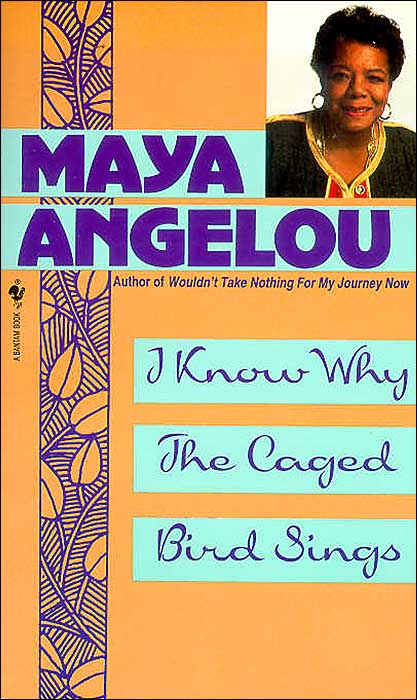
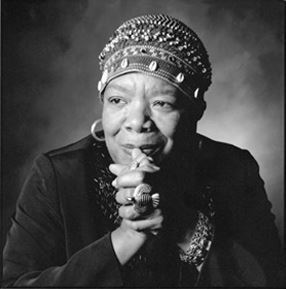
 Portrait of Maya AngelouAdria Richards [CC BY-SA 2.0 (https://creativecommons.org/licenses/by-sa/2.0)]For a time during W.W. II, the teenagers lived in a junkyard, forming a loose-knit but mutually caring community. They slept in abandoned cars at night, and during the day raised money by doing odd jobs, collecting empty bottles and returning them for small change, and by entering the weekly jitterbug contest at the Silver Slipper. They shared money and chores and, most important, kept each other company. One of those children would remember the group in the junkyard, with some surprise that, as she wrote years later, it "could initiate me into the brotherhood of man . . . I was never again to sense myself so solidly outside the pale of the human race."
The young woman, who not only won second prize one weekend at the Silver Slipper dance contest, but went on to become a professional dancer, was Maya Angelou. After spending a terrible few days with her father and his girlfriend, she had run away and found herself in this community of homeless children. But it was not an episode out of step with the rest of Angelou's life. Raised by her grandmother in Arkansas, and her mother in St. Louis and later San Francisco, Angelou was accustomed, as too many children are, to being moved from home to home, from one set of relatives to another. Yet she was fortunate for this too: her mother and grandmother had, in their separate times and ways, given her a great deal of love and learning. After her month in the junkyard, she returned to her mother and stayed there until a few years later, when she had a young child, and was ready to live on her own.
We, this people on a small and lonely planet
Traveling through causal space
Past aloof stars, across the way of indifferent suns
To a destination where all signs tell us
It is possible and imperative that we discover
A brave and startling truth
And when we come to it
To the day of peacemaking
When we release our fingers
From fists of hostility
And allow the pure air to cool our palms
When the curtain falls on the minstrel show of hate
And faces sooted with scorn are scrubbed clean
When battlefields and coliseum
No longer rake our unique and particular sons and daughters
Up with the bruised and bloody grass
To lie in identical plots in foreign lands
When the pennants are waving gaily
When the banners of the world tremble
Stoutly in the good, clean breeze
When we come to it
When we let the rifles fall from our shoulders
And children dress their dolls in flags of truce
When land mines of death have been removed
And the aged may walk into evenings of peace
When religious ritual is not perfumed
By the incense of burning flesh
And childhood dreams are not kicked awake
By nightmares of abuse
When we come to it
Then we will confess that not the Pyramids
With their stones set in mysterious perfection
Not the Garden of Babylon
Hanging as eternal beauty
In our collective memory
Not the Grand Canyon
Kindled in delicious color
By Western sunsets
Not the Danube flowing in its blue soul into Europe
Not the sacred peak of Mount Fuji
Stretching to the rising sun
Neither Father Amazon nor Mother Mississippi who, without favor,
Nurture all creatures in the depths and on the shores
These are not the only wonders of the world
When we come to it
We, this people, on this minuscule and kithless globe
Who reach daily for the bomb, the blade, the dagger
yet who petition in the dark for tokens of peace
We, this people on this moat of matter
in whose mouths abide cantankerous words
Which challenge our existence
Yet out of those same mouths
Can come songs of such exquisite sweetness
That the heart falters in its labor
And the body is quieted into awe
We, this people, on this small and drifting planet
Whose hands can strike with such abandon
That in a twinkling, life is sapped from the living
Yet those same hands can tough with such healing, irresistible tenderness
That the haughty neck is happy to bow
And the proud back is glad to bend
Out of such chaos, of such contradiction
We learn that we are neither devils or divines
When we come to it
We, this people, on this wayward, floating body
Created on this earth, of this earth
have the power to fashion for this earth
A climate where every man and every woman
Can live freely without sanctimonious piety
And without crippling fear
When we come to it
We must confess that we are the possible
We are the miraculous, the true wonders of this world
That is when, and only when
We come to it.
Having learned the Jitterbug, the Lindy and the Half Time Texas Hop at balls in the city auditorium, Angelou discovered that she had a love of dancing. Formal studies in San Francisco led to a professional career, and in the fifties she toured Europe and Africa, dancing, singing and acting, returning to the United States to make her living by singing in nightclubs. Her talents, combined with her intellect and grace, brought her to the attention of the world, and soon she was asked by Dr. Martin Luther King, Jr. to assume the role of Northern Coordinator for the Southern Christian Leadership Conference. For many years she lived in Egypt and Ghana, writing and studying the relationship between African culture and that of black Americans. After coming home to the United States, she became a television producer and wrote, produced and directed a series about African-Americans. Most recently she has been living in North Carolina, writing and teaching college courses, and was asked to read her poetry at Bill Clinton's 1996 Presidential Inauguration.
Maya Angelou did not have an easy beginning. She suffered constant displacement, longing for one lost home after another, and experienced an episode of abuse that resulted in tragedy. Years into adulthood, she would write about being the "plain" member of a family that, for her, was "handsome to a point of pain." Yet pictures of Maya Angelou as a grown woman do not bear out such a recollection of ugliness. It would seem as if the intangible sadnesses of Angelou's youth bled into her remembered self-portrait; as if pain had actually attempted to substantiate itself in her appearance.
In response to this pain, she created works of art. Her latest book, Even the Stars Look Lonesome, contains this observation: "The strength of the Black American to withstand the slings and arrows and lynch mobs and malignant neglect can be traced directly to the arts of literature."
Page created on 8/16/2014 12:07:02 PM
Last edited 9/28/2021 10:19:16 PM
The Associated Press
ATLANTA (AP) _ From her New York apartment, Maya Angelou saw smoke billowing from the World Trade Center on Sept. 11. Now, she says hope has replaced the horror of that sight.
"I can see in the acorn the oak tree," Angelou said. "I see the growth, the rebuilding, the restoring. I see that is the American psyche. There is so much we can draw understanding from. One of the lessons is the development of courage. Because without courage, you can't practice any of the other virtues consistently."

Leticia and Leeanna both wrote about Maya Angelou during the MY HERO workshop at the Chicago Public Library:
Leticia from Naperville wrote:
Maya Angelou is like a third grandmother to me because she is full of wisdom, courage and love. Maya Angelou is a very unique woman. The first book I read was THE HEART OF A WOMAN and I thought it was a very good book. I would recommend this book to any Black woman to read.
Maya Angelou is the best author that I know of...
Leeanna wrote:
My hero is Maya Angelou because I love the poetry she writes. Her poetry is very understanding to me and it is also very deep.